
A chatbot that qualifies leads without annoying them
Most enquiry forms ask ten questions and get answered by nobody. A qualification bot asks the same things one at a time, and finishes the conversation.
You are paying for enquiries and your sales team is spending its morning on calls that should never have been booked: wrong city, no budget, looking for something you do not offer. Meanwhile the form on the landing page asks for eleven pieces of information and most visitors never reach the submit button.
A qualification bot sits in that gap. Done properly it collects the handful of facts a human needs before the first conversation, books the ones worth booking, and routes the rest. Done badly it is a popup that argues with people.
What a qualification bot is for, and what it is not
It is for four things:
- Answering the questions that stop people enquiring. Price range, location, availability, whether you handle their situation.
- Collecting the facts that decide what happens next. Need, urgency, location, budget or insurance, contact details.
- Booking, straight into a real calendar with real availability.
- Routing, so a qualified lead reaches the right person with the transcript attached.
It is not a replacement for your sales team, a place to put your entire website, or a negotiation tool. It should not try to close, should not handle complaints, and should not be the last line of defence on anything clinical, legal or financial. The moment a bot is doing a job a person should do, it stops being an asset and becomes a reason people distrust your brand.
The questions it should ask before a human gets involved
Four or five, one per message, in the order a person would ask them. For each one, write down what you will do differently depending on the answer. If the answer changes nothing, cut the question.
| # | Question | Why it earns its place | CRM field |
|---|---|---|---|
| 1 | What do you need help with? | Routes to the right team or service, and sets the rest of the flow | enquiry_type |
| 2 | When do you need it? | Urgency decides who calls first and how fast | timeline |
| 3 | Where are you based? | Rules out anyone outside your service area or licence | location |
| 4 | Budget, insurance or property range | The one question that disqualifies most, so it goes late | budget_band |
| 5 | Name and best number or WhatsApp | Asked last, once the conversation has given something | name, phone |
Two refinements worth building. Ask the disqualifying question after the person has had something useful, not before. And never ask for information you already have: if the enquiry came from a Meta lead form or a GoHighLevel contact record, the bot should greet them by name and skip those steps. Your CRM and funnel setup is what makes that possible.
Keep the whole flow under about eight exchanges. Every extra question costs completions, the same way every extra form field does.
How it hands over, and when it must
Handover is the part most builds get wrong. Three things have to be true: the person receiving the lead gets the full transcript, not a summary; the visitor is told plainly what is happening and roughly when; and if nobody is available, the bot books a time rather than promising a call that never comes.
Hand over immediately, every time, on:
- Price negotiation. Quoting a range is fine. Discounting is not.
- Clinical, medical, legal or financial advice. Symptoms, diagnosis, medication, eligibility, contracts.
- Complaints and anything emotional. A bot that replies to a distressed message with a booking link is a reputational problem.
- Vulnerability signals. Any safeguarding or crisis language should trigger a person and your documented escalation route, not a flow.
- A direct request. The second time someone asks for a human, they get one.
- Two failed attempts to understand. Looping is what makes people hate chatbots.
For out-of-hours handovers, the bot should be honest: say when someone will reply, offer the next three calendar slots, and send the confirmation on the channel the conversation is already in.
Why conversational qualification completes more often than a long form
A form shows you all of its questions at once. Before it has given you anything, it asks for everything, and the visitor has to decide in one go whether the whole thing is worth it. A conversation inverts that. It asks one thing, answers one thing, and each reply feels like progress rather than paperwork. It also lets you adapt: a visitor who says “I’m ready to book” should not be walked through the full qualification script.
This is not theoretical. A therapy practice came to us with a long web intake form that most visitors abandoned, and staff were manually matching the people who did finish to a therapist. We replaced it with a conversational flow that asks one question at a time, detects intent, shows insurance options and captures location in the chat. Intake completion tripled and 40% more qualified leads booked a session, with median qualification time under two minutes.
Guardrails so it never invents an answer
Assume the model will confidently say something wrong unless you make that structurally difficult.
| Question type | What the bot should do | What it must never do |
|---|---|---|
| “How much is X?” | Give your published range or starting price, then offer a quote from a person | Estimate, discount or negotiate |
| “Is this covered by my insurance?” | List the insurers you work with and offer to have someone confirm the policy | Confirm cover for a specific policy |
| “I have these symptoms, what is it?” | Acknowledge, offer an appointment, escalate | Interpret symptoms or suggest treatment |
| Something not in the knowledge base | Say it will get a person to confirm, and create the task | Improvise from general knowledge |
| A competitor comparison | Stay factual about what you do | Make claims about anyone else |
In practice that means the bot answers from an approved knowledge base rather than from the model’s memory, and that “I will have someone confirm that for you” is a success state in your test set, not a failure. Add a small set of scripted responses for the questions you cannot afford to get wrong, and log every answer so you can review the first few hundred conversations line by line. We treat that review as part of the build, not an optional extra, and the same evaluation discipline applies to the larger AI agents we put into production.
What you need to give it before launch
Nothing here is AI work, and all of it is the difference between a bot that works and a demo:
- Written answers to your 30 most common questions. Prices or ranges, locations, hours, services, what you do not do, policies. If your team answers it ten times a week, it belongs here.
- A calendar with honest availability, including buffers, practitioner or agent mapping, and appointment durations.
- The CRM fields the bot will write to, created and named before the build, plus the tags and pipeline stages a qualified lead should land in.
- Routing rules. Who gets which enquiry type, in which hours, and what happens when they do not respond.
- A disqualification path that is still polite. Out-of-area and out-of-budget enquiries should get a useful answer and, where you have one, a referral.
- Your escalation policy, written down, for the clinical, legal and safeguarding cases above.
Decide early which channel it lives on. For property enquiries and most Gulf and Pakistan markets, WhatsApp is where the conversation already happens; for a clinic, the website widget plus WhatsApp usually covers it. Conversations do not have to be typed either: we built a WhatsApp assistant for low-literacy users that works entirely through voice notes and photographs, using speech-to-text and image recognition, and it scored 4 out of 5 for usability in real-user testing.
Measure the right four numbers
Conversations started. Qualification completed, as a percentage of conversations started. Bookings or qualified handovers made. And the one everybody skips: the proportion of those bookings your sales team considers worth having. A bot that doubles bookings and halves their quality has made your week worse.
Review the transcripts of the handovers weekly for the first month. Every question the bot could not answer is a line to add to the knowledge base, and every bad booking is a qualification question to tighten.
What this looks like when we do it
The therapy practice above is the clearest version: a Landbot conversational flow asking one question at a time, OpenAI handling intent detection and therapist matching, insurance browsing and location capture inside the chat, and Asana plus the CRM picking up the routing so staff only touch qualified cases. Completion tripled and qualification now takes under two minutes. The full build is the therapy practice lead qualification bot. Where typing is the barrier rather than the form, we build the same logic around voice and images instead, as in the WhatsApp voice and vision chatbot.
Where to start
If you have the 30 answers written and a calendar that reflects reality, you can build a useful first version yourself and add the AI layer later. If what you have is a long form, a shared inbox and a team that answers the same questions all day, the quicker route is to have the conversation design, the knowledge base, the WhatsApp or website assistant and the CRM wiring built as one piece, usually live in one to two weeks.
Either way, fix response time first: a bot that qualifies beautifully and then leaves someone waiting four hours for a call has solved the wrong half of the problem. Book a free audit if you want a strategist to look at your current enquiry flow and tell you which half is costing you more.
Common questions
What should an AI chatbot ask to qualify a lead?
Only what changes what happens next: what they need, how urgent it is, where they are, their budget or insurance situation where relevant, and how to contact them. Four or five questions, one per message, in the order a human would ask them. Anything a salesperson can establish in ten seconds on the call should wait for the call.
Is a chatbot better than a contact form for lead generation?
For anything longer than three fields, usually yes. A form shows all its questions at once and asks for commitment before it has given anything; a conversation reveals one question at a time and feels like progress. For a therapy practice we replaced a long intake form with a chat flow and completions tripled.
When should an AI chatbot hand over to a human?
On price negotiation, clinical or legal questions, complaints, anything involving a vulnerable person, and whenever the visitor asks for a person. It should also hand over when it has failed to understand twice. The handover must pass the full transcript so nobody has to repeat themselves.
Will an AI chatbot make things up about my prices?
It will if you let it answer from the model's general knowledge. The fix is architectural: the bot answers only from an approved knowledge base, price questions return your published ranges or a promise that a human will confirm, and anything outside the knowledge base triggers a handover rather than an invention.
How long does it take to launch a qualification bot?
A WhatsApp or website assistant usually goes live in one to two weeks. Most of that is not the AI. It is agreeing the qualification questions, writing the knowledge base, connecting the calendar and CRM, and testing the handover rules with the people who will receive the leads.
Proof from our work
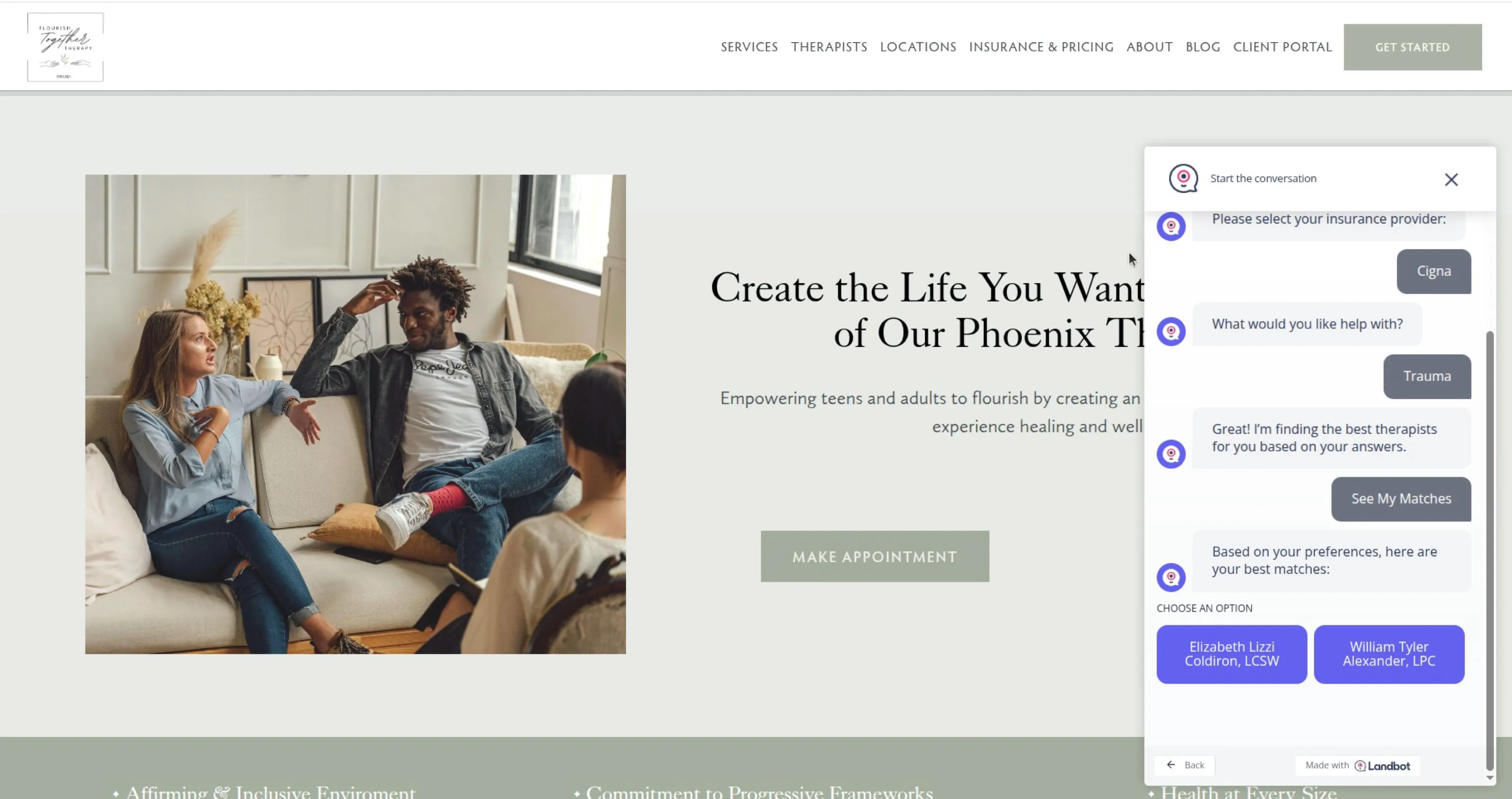
Intake form completion vs the old form
A conversational chatbot for a therapy practice that qualifies prospective clients, matches them to the right therapist, shows insurance options and captures location in a friendly chat flow. Intake completion tripled.
Read case study
Usability score in real-user testing
A GPT-4-based WhatsApp chatbot designed for Pakistan's 60 million low-literacy adults. Speech-to-text, text-to-speech and image recognition were combined into a modular pipeline optimised for low-end phones, so users interact entirely by voice and photos. Real-user testing scored 4 out of 5 for usability.
Read case study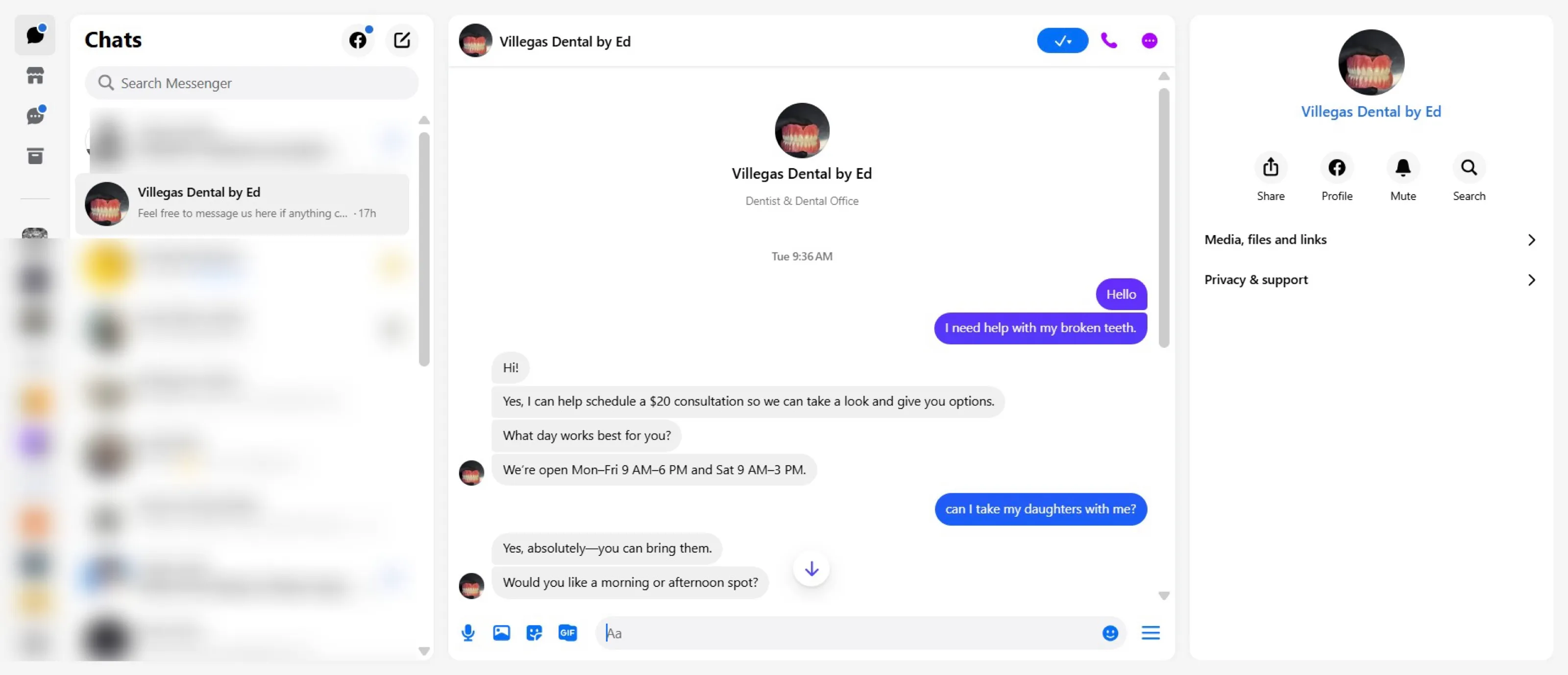
Bookings taken with no staff involvement
An AI chatbot for dental clinics that books appointments on its own: it answers instantly on Messenger, guides the patient through a natural conversation, checks availability and confirms the slot. Bookings sync to Google Calendar and Google Sheets in real time, so patients can book outside clinic hours and the front desk sees everything.
Read case study