
The Klaviyo flows that matter, in the order to build them
There are about forty flows you could build in Klaviyo and seven that produce nearly all the revenue. Build them in the wrong order and you spend a month on the one that earns least.
You open Klaviyo, see the flow library, and there are dozens of templates all claiming to make money. So you build the one that looks most interesting, usually a VIP tier or a birthday email, and three months later flows are still producing a small fraction of your email revenue.
The flows are not equally valuable, and the gap is enormous. Here is the order we build them in and why, with what each one is actually for.
The build order, and the reasoning
Ordered by revenue per hour of setup, which is the only ranking that matters when you have a limited number of hours.
| Order | Flow | Build time | Why here |
|---|---|---|---|
| 1 | Checkout + cart abandonment | ~4 hours | Highest intent audience that exists in your account |
| 2 | Welcome | ~5 hours | Largest entry volume, and it sets your engagement baseline |
| 3 | Post-purchase + review request | ~4 hours | Earns reviews and second orders, which lift everything else |
| 4 | Browse abandonment | ~2 hours | Cheap to build, meaningful volume, low intent |
| 5 | Replenishment | ~3 hours | Enormous for consumables, pointless for one-off goods |
| 6 | Winback | ~3 hours | Recovers margin you have already paid to acquire |
| 7 | VIP | ~4 hours | Needs a list big enough to have a real top 10% |
If you only ever build the first three, you will capture most of the money. The post-purchase flows were the missing half of the programme at HydroHealth, and building them is a large part of why that account returned 63× in 60 days, measured against total store revenue rather than email attribution.
The pre-purchase flows
Checkout and cart abandonment
Trigger: started checkout, and separately added to cart. Timing: checkout at 1 hour, 24 hours, 48–72 hours. Cart at 4 hours and 24 hours. Emails: three and two.
Email one reminds, showing their exact items and one button. Email two answers the objection that stopped them: delivery, returns, sizing, payment. Email three gives a reason to decide now, and is the only place an incentive belongs.
The mistake: running one flow for both triggers, and putting a discount in email one. You pay a code to everybody who was returning anyway. The full sequence, including how to measure what it really recovered, is in the abandoned cart email flow.
Welcome
Trigger: subscribed to a list, via pop-up or footer. Timing: immediately, 24 hours, 72 hours, day 6. Emails: four.
Email one delivers whatever you promised in the pop-up and nothing else, because the promised thing is why they are here. Email two is the brand: who makes this, how, why it costs what it costs. Email three is the proof: bestsellers, reviews, the category most people start with. Email four handles the objection and closes, with the incentive expiring if you offered one.
The mistake: sending only email one. The code arrives, it does not get used, the subscriber goes quiet, and you have manufactured a disengaged profile that will drag your sending reputation down for a year.
Browse abandonment
Trigger: viewed a product, no add to cart, within 24 hours. Timing: 4 hours, then 48 hours for high-consideration categories. Emails: one, sometimes two.
Keep it soft. These people did not add anything to a cart. One product image, two or three alternatives from the same collection, no urgency.
The mistake: treating it like cart abandonment and shouting. The intent is not there, the unsubscribe rate shows it immediately, and you have spent your sender reputation on the weakest signal in the account.
The post-purchase flows
Post-purchase and review request
Trigger: placed order. Timing: day 1, day 7, then the review request timed to arrive a few days after likely delivery. Emails: two plus the review request.
Day one sets expectations and reduces the “where is my order” support load. Day seven is care and use: how to wear it, wash it, assemble it, get the most from it. Then ask for the review, with the specific product in the email, and nothing else competing for the click.
The mistake: asking for a review before the parcel has arrived. Base the delay on your real delivery time by region, not a global seven days, and segment first-time from repeat buyers so a fifth-time customer does not get the beginner’s guide.
Replenishment
Trigger: ordered a specific consumable product. Timing: at roughly 80% of the typical interval between first and second purchase for that product. Emails: two, a reminder and a follow-up a week later.
Work out the interval from your own order data rather than guessing. Klaviyo will show you the median days between first and second order.
The mistake: building this for products nobody rebuys. For apparel and most one-off goods, skip it entirely and put the hours into winback. For supplements, skincare and anything consumed, this flow often pays for the whole programme.
The re-engagement flows
Winback
Trigger: has placed an order, no order since, at a threshold set from your repeat cycle. For most stores somewhere between 90 and 180 days. Timing: at the threshold, then +10 days, then +30. Emails: three.
Email one is “here is what is new since you last bought”. Email two is the bestseller in the category they bought from. Email three is the offer, and this is a place where a discount is defensible, because the alternative is a customer you have already paid to acquire buying nothing.
The mistake: one threshold for every product. A customer who buys coats once a year is not lapsed at 90 days, and a customer who buys protein powder monthly is lapsed at 60.
VIP
Trigger: entering a segment defined by lifetime spend or order count, set at roughly your top 10%. Timing: on entry, then an ongoing perk cadence. Emails: two on entry, then occasional.
Early access, first look at a launch, a note from a person rather than a template. The perk should be access, not money off, because your best customers are not the ones who need the money off.
The mistake: building this on a list of two thousand people, where the top decile is two hundred and the whole thing moves less revenue than fixing your welcome email would.
What we would not build yet
Birthday flows, back-in-stock on a store with no stock-out problem, price-drop alerts on a brand that does not discount, and anything with more than five emails before a purchase. They are not wrong, they are just further down the list than they look, and every extra flow is something somebody has to maintain and measure. We would rather run seven flows you can explain than twenty-five nobody checks.
How to know a flow is working
Judge each flow on revenue per recipient, not open rate, and judge the set on what share of email revenue comes from flows rather than campaigns. Hold back 5–10% of eligible profiles from a flow for a month and compare revenue per eligible profile, because that difference is what the flow earned rather than what it was credited with. If the numbers stay flat across every flow, the problem is upstream in deliverability and segmentation, which is where an email list that is not converting begins.
What this looks like when we do it
For a luxury clothing brand we built the full flow set, welcome through to VIP, each written in the brand’s voice, with the list segmented by purchase history and engagement so campaigns went to people likely to buy. Over twelve months Klaviyo attributed $1.14M to email, 27% of the store’s total revenue. The number worth noting is not the headline: 69% of it came from the flows, which means it keeps arriving in a month when nobody sends a campaign. Open rates stayed above 58% and the spam complaint rate was zero, which is the segmentation doing its job.
Where to start
Count your live flows and ask which of the seven above are missing. If checkout abandonment and welcome are not both built with more than one email each, you already know what to do this week, and you can do it without an agency.
If you sell fashion and apparel and the list is large but quiet, the flows are not the first problem. When you want the whole set built, written and segmented properly, that is our email and SMS work. Or take the free audit: a strategist reviews your Klaviyo account beforehand and you keep the one-page plan whether you hire us or not.
Common questions
Which Klaviyo flow should I build first?
Checkout abandonment. It triggers on people who reached the payment page and gave you an email address, so it reaches the highest intent audience in your account, and three emails take roughly three hours to build. Nothing else in Klaviyo returns as much per hour of setup.
How many Klaviyo flows do I actually need?
Seven cover almost all of it: checkout and cart abandonment, welcome, post-purchase, review request, browse abandonment, replenishment or winback depending on what you sell, and VIP. Stores with twenty-five flows are usually maintaining twenty they cannot measure.
How much of my email revenue should come from flows?
More than half, and often around two thirds. On a luxury clothing brand we run, flows produced 69% of email revenue over twelve months. If campaigns are carrying most of your email revenue, your automated flows are either missing or badly timed.
How long does it take to build a full Klaviyo flow set?
Two to three weeks for seven flows with written copy, branded templates, segmentation and testing. The build itself is faster than that. The time goes on copy that sounds like the brand and on checking exclusions so nobody receives two flows at once.
Do I need SMS in my Klaviyo flows?
Only in checkout abandonment, order confirmation and shipping updates, and only for people who gave explicit SMS consent. SMS in welcome or browse abandonment flows burns a list you paid to build, and the opt-out rate will tell you so within a fortnight.
Proof from our work
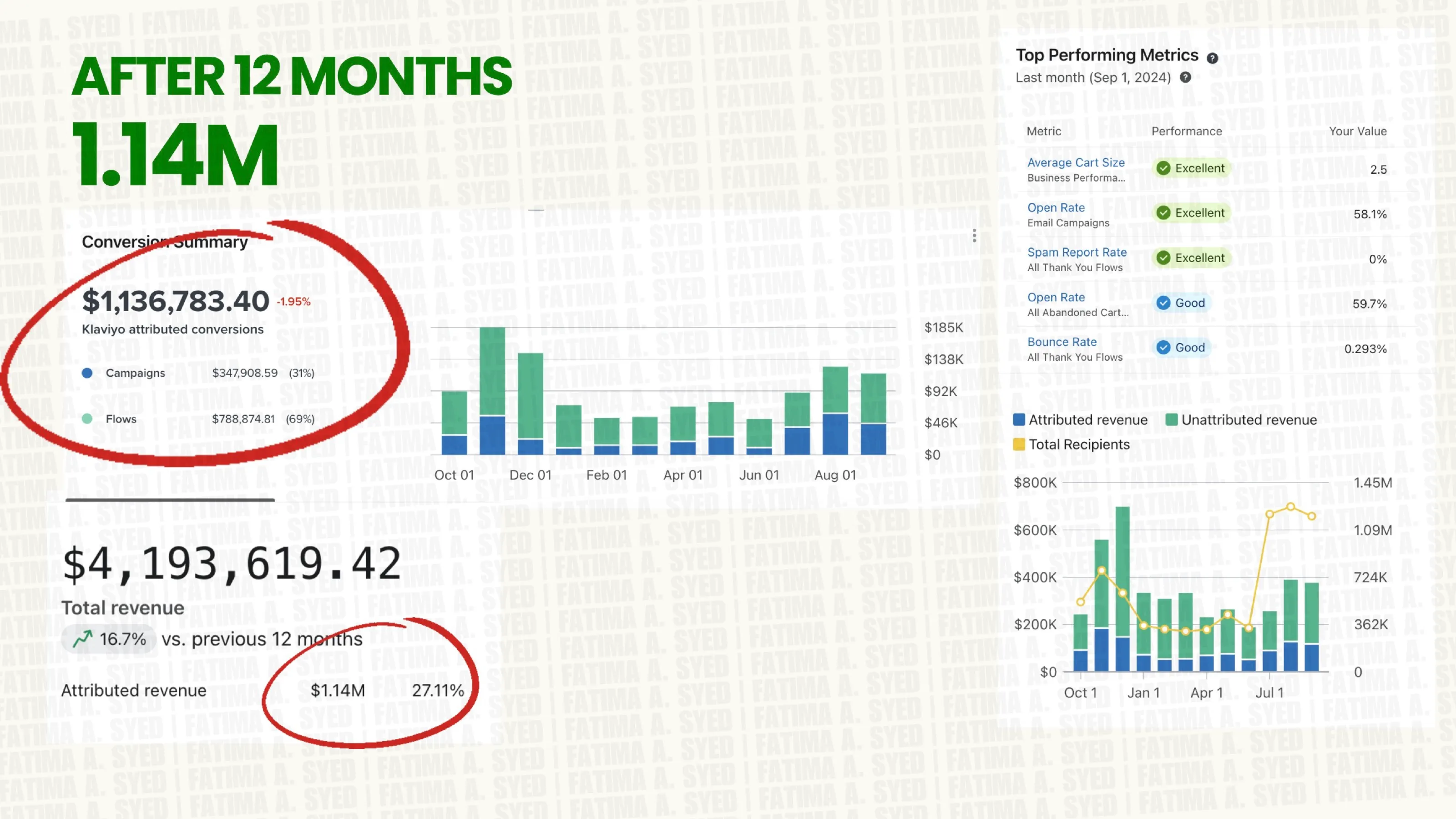
Email-attributed revenue in 12 months, 27% of store revenue
For a luxury clothing brand we built Klaviyo into a revenue channel: $1.14M attributed to email in twelve months, 27% of the store's $4.19M total. Automated flows produced 69% of it, campaign open rates stayed above 58% and the spam complaint rate was zero.
Read case study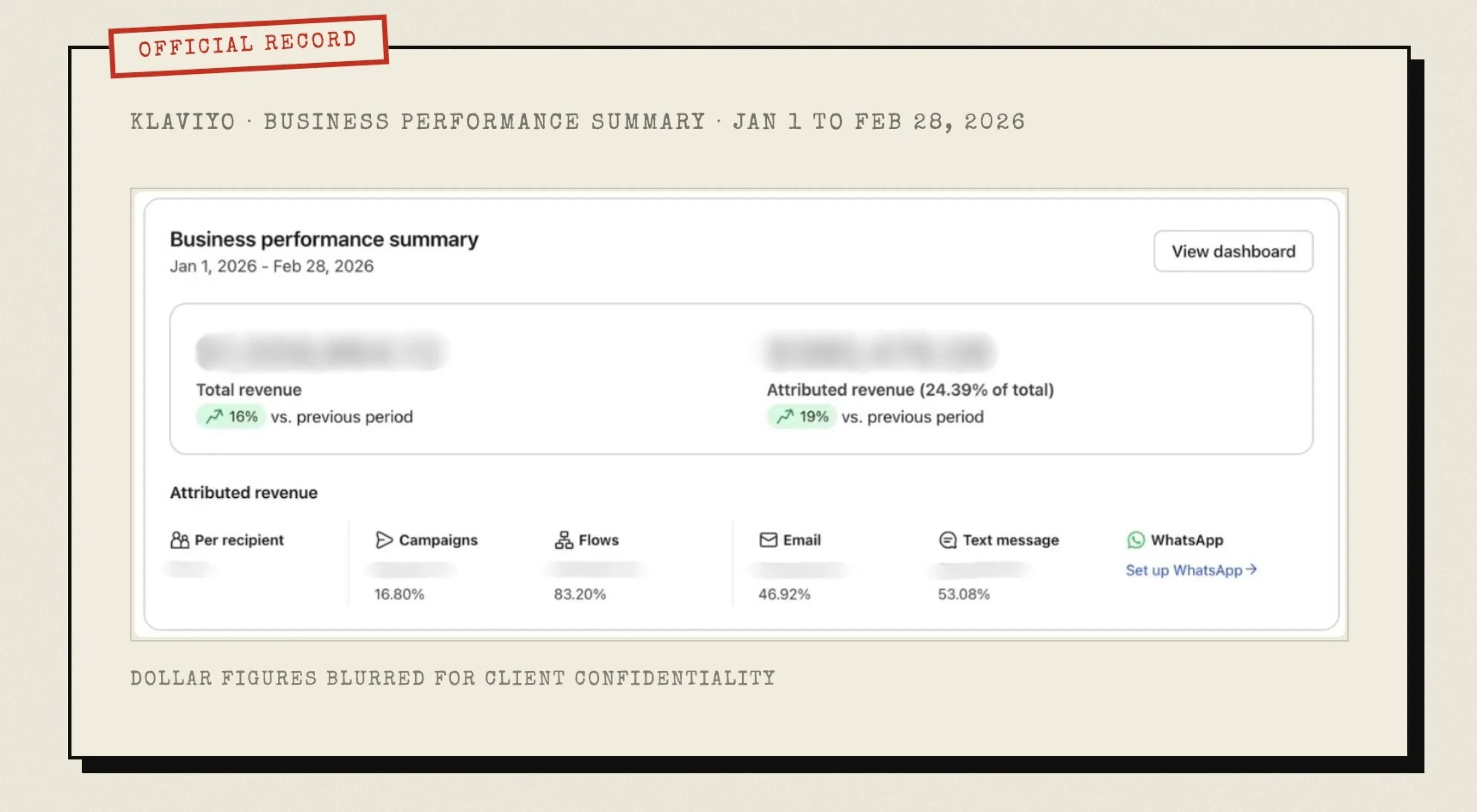
In the first 60 days, measured on total store revenue
HydroHealth had pre-purchase flows that underperformed and no post-purchase flows at all. We rebuilt the former and built the latter from nothing, covering strategy, copy, design and build in Klaviyo. The new system beat the old one by more than 2×, total revenue rose 16% and the programme returned 63× in 60 days.
Read case study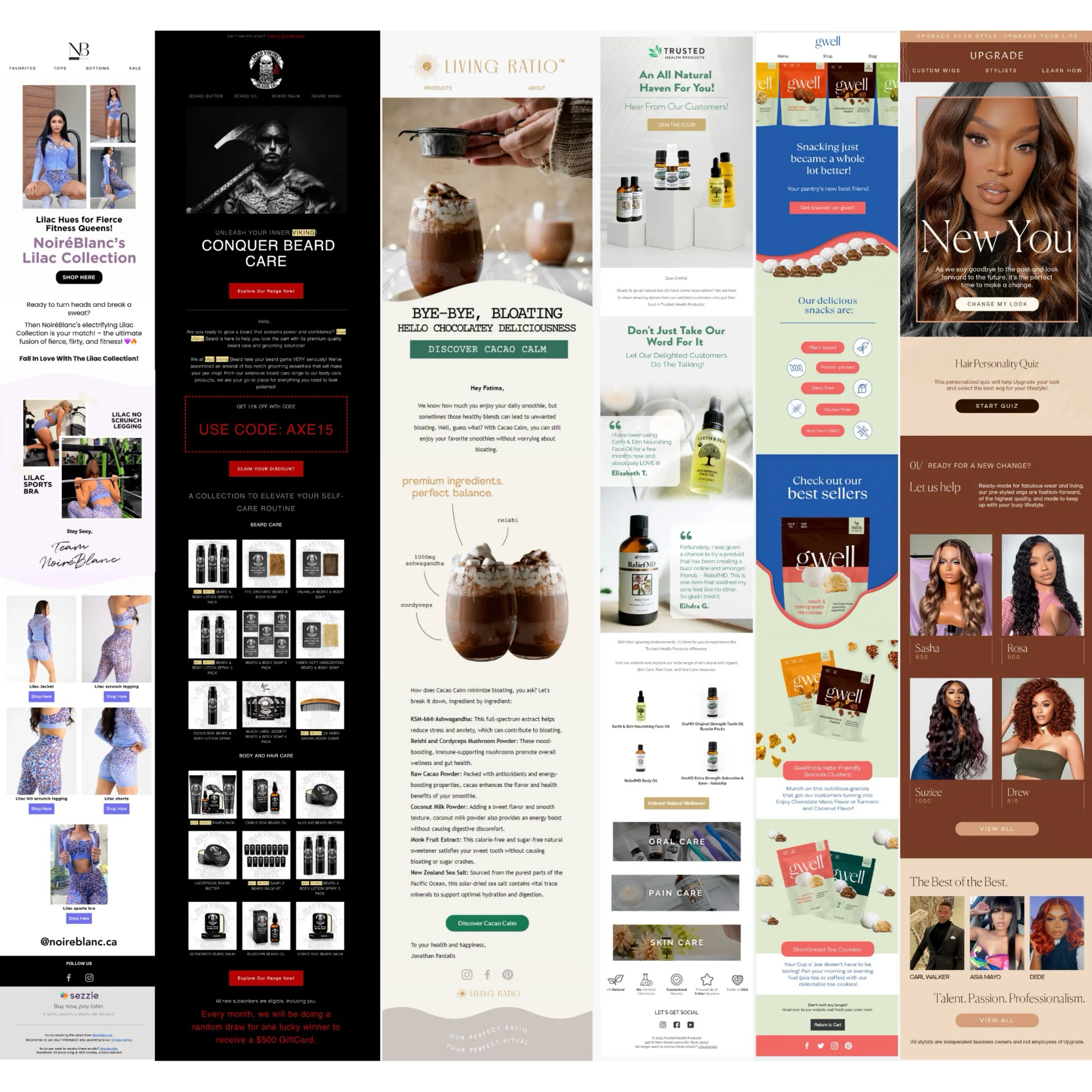
Email newsletter designs for fashion, beauty and haircare
- Collection-launch newsletters for a fashion label with product grids and lookbook imagery
- Promotional campaigns for men's grooming and skincare with offer codes and product…
- Bestseller and routine emails for a haircare brand