
GoHighLevel or HubSpot: which one fits you
Both are good products aimed at different buyers. The wrong choice costs you a year and a migration, so it is worth being clear about which buyer you are.
You have outgrown a spreadsheet and a shared inbox. Two names come up in every search, and the comparison articles are mostly written by people earning a commission on one of them.
Both are good products. They are built for different buyers, and the cost of picking the wrong one is not the subscription, it is the year you spend in it plus the migration out. So here is how we actually decide when a client asks, including the cases where we recommend the one we are not an agency partner for.
How the two pricing models differ
This is the real fork in the road, more than any feature list.
GoHighLevel charges a flat monthly rate per account. Users and contacts are included at the tiers most businesses use, and the marketing tooling comes with it. Messaging is the exception: email, SMS and phone usage is metered and billed on top of the subscription, so your bill moves with your send volume.
HubSpot charges by hub, tier and seat. There is a free CRM to start on, then Starter, Professional and Enterprise tiers across Marketing, Sales, Service and Content, with Marketing Hub priced on the number of marketing contacts you hold. Professional tiers add onboarding fees and the per-seat model means your cost rises as the team does.
Neither model is wrong. A three-person service business with 40,000 contacts and heavy SMS use gets a very different answer from a twelve-person sales team with a small, high-value list. Check both pricing pages before you commit, because the tiers and limits change and today’s published figures are the only ones worth planning around.
What GoHighLevel bundles that you would otherwise buy
Inside one subscription you get the CRM and pipelines, booking calendars, two-way SMS and WhatsApp conversations in a shared inbox, email marketing, funnel and website building, forms and surveys, review requests, call tracking and recording, courses and memberships, workflow automation, and sub-accounts.
For a service business that is the entire stack in one place. The honest version of the trade-off: each of those modules is good enough rather than best in class. The funnel builder will not satisfy a designer, the email editor is functional, and the reporting answers “what happened” better than “why”. What you are buying is one login, one bill, and automations that can touch every part of the process without an integration in between.
Where HubSpot is genuinely stronger
Four areas, and they are not small ones.
Reporting and attribution. Custom report builder, multi-touch attribution, revenue reporting across the funnel. If someone asks which campaign produced the pipeline that closed last quarter, HubSpot answers it properly.
The data model. Companies as first-class records, associations between objects, and custom objects at Enterprise. If your business sells to organisations with multiple contacts, several deals and renewals, that structure matters more than any feature.
Governance and process. Granular permissions, teams, approval steps, audit history, deal stage requirements, forecasting and sequences. These are the things a sales manager needs once there are more than a handful of reps.
Integrations. A large, mature app marketplace and well-documented APIs. If your business depends on a specific accounting, telephony or industry tool, check that integration first; it may settle the question on its own.
SMS, WhatsApp and calendars
For most service businesses this section decides it, because messaging and booking are the daily work.
GoHighLevel treats SMS as a first-class channel: numbers provisioned inside the platform, two-way conversations in the same inbox as email and WhatsApp, and SMS steps available in any workflow. Calendars are native, with team availability, round-robin assignment, buffers and automated confirmation and reminder sequences. That is why appointment-led businesses tend to settle there, and why it is the platform we most often use to build reminder sequences that cut no-shows.
HubSpot has a strong meetings tool tied to your calendar and deal records, and SMS and WhatsApp as channels in the conversations inbox from Marketing Hub Professional upwards. It is well built, but messaging is an addition to a CRM rather than the centre of the product, and the tier requirement means small teams often end up paying for a lot of other things to reach it.
White-label and agency resale
If you are an agency, this is probably the whole decision. GoHighLevel can be rebranded as your own software, sold to your clients on your domain and billed by you, with sub-accounts per client and snapshots that deploy a complete setup to each new one. There is no equivalent in HubSpot, which has a solutions-partner programme instead: you implement and manage HubSpot for clients, but it stays HubSpot.
We build both sides of that. A SaaS snapshot an agency can deploy to every new client, or a plain CRM and funnel setup in whichever platform the client already owns.
Migration effort, in both directions
Contacts, companies and deals move as CSV exports and imports, with a field-mapping session and some cleanup. Everything else is a rebuild. Workflows, forms, landing pages, email templates, reports, dashboards and integrations have no migration path between the two platforms, and no tool will do it for you.
A realistic plan for a small business:
- Export and clean the data. Deduplicate before import, not after.
- Map the fields and pipeline stages, and delete the ones nobody has filled in for a year.
- Rebuild only the automations that are running, which is usually fewer than you think.
- Move forms and pages, with 301 redirects for anything hosted and indexed.
- Warm up sending from the new platform instead of switching your whole email volume on day one.
- Run both in parallel for two weeks, with one system clearly the source of truth.
Budget one to two weeks of focused work. The part people underestimate is not the build, it is agreeing what the process should be now rather than copying across a system that already did not fit.
Side by side
| GoHighLevel | HubSpot | |
|---|---|---|
| Pricing model | Flat rate per account, users and contacts included | Per seat and hub tier, Marketing Hub on marketing contacts |
| Free tier | No, trial only | Yes, free CRM |
| Funnels and websites | Included | Content Hub or a third-party builder |
| Two-way SMS and WhatsApp | Core to the product, usage billed | From Marketing Hub Professional, usage billed |
| Booking calendars | Native, team and round-robin | Native meetings tool tied to records |
| Reviews and reputation | Included | Via marketplace apps |
| Reporting depth | Operational, dashboard level | Custom reports and attribution |
| Data model | Contacts, opportunities, custom fields | Objects, associations, custom objects at Enterprise |
| Permissions and approvals | Basic | Granular |
| App marketplace | Growing, plus webhooks and Zapier or n8n | Large and mature |
| White-label resale | Yes, full SaaS mode | No |
| Best fit | Small service businesses and agencies | Growing sales teams and structured processes |
Choose GoHighLevel if
You run a service business, clinic, gym, practice or local trade where the work is capturing enquiries, replying fast, booking appointments and following up. You want funnels, SMS, calendars and review requests on one bill. Your sales process is one or two stages and a conversation, not a six-month cycle with procurement. Or you are an agency that wants to sell the platform under its own name. For that buyer, the bundled tooling and the flat rate are hard to beat, which is why most of the automation work we do for service businesses lands there.
Choose HubSpot if
You have a sales team that will grow past five or six people, deals that involve several contacts at one company, and a process with real stages and forecasting. You need to report attribution credibly to a board or an investor. You depend on a specific integration in its marketplace. Or you sell to businesses that expect the structure HubSpot imposes. In that case the per-seat cost buys reporting and governance you would otherwise build badly in spreadsheets.
What this looks like when we do it
Most of what makes either platform work is unglamorous: pipeline stages that match how you actually sell, calendars with honest availability, custom fields someone will fill in, and workflows that chase a lead without a human remembering to. Our GoHighLevel CRM setup for leads and bookings is a good example of the shape of it: account structure, sales stages, calendars, automated email and SMS journeys, user access, tags and conversion tracking, built so nothing sits in an inbox. We build the same architecture in HubSpot when that is the right platform.
The decision in front of you
Write down three things: how many people will have a licence in a year, how many contacts you hold, and the one report your business genuinely needs. Those three answers will point at one of the two more reliably than any feature comparison, including this one.
If the answers are close, the tiebreaker is usually speed to first reply, not the CRM, and that is worth measuring before you migrate anything. Or take the free audit: a strategist looks at your current setup beforehand, 30 minutes, and you keep a one-page plan whichever platform it recommends.
Common questions
Is GoHighLevel cheaper than HubSpot?
For a small service business, usually yes, because GoHighLevel charges a flat monthly rate per account with users and contacts included, and bundles funnels, SMS, calendars and review tools. HubSpot charges per seat and per hub tier, with Marketing Hub priced on marketing contacts. Compare the total of the tools you would otherwise buy separately, not the headline price.
What does GoHighLevel include that HubSpot charges extra for?
Funnel and website building, two-way SMS and WhatsApp conversations, booking calendars, review requests, call tracking, courses and memberships, and agency sub-accounts all sit inside the standard GoHighLevel subscription. In HubSpot several of those need a higher hub tier, extra seats or a third-party app, though messaging usage is charged separately in both.
Where is HubSpot genuinely better than GoHighLevel?
Reporting and attribution depth, the data model including custom objects, granular permissions and approvals, forecasting and sequences for a real sales team, and the size of its app marketplace. If your constraint is reporting to a board or running a multi-stage sales process with several reps, that is HubSpot's home ground.
How hard is it to migrate from HubSpot to GoHighLevel?
Contacts, companies and deals export and import cleanly as CSV. Everything else is a rebuild: workflows, forms, landing pages, email templates, reporting and integrations have no migration path between the platforms. For a small business expect one to two weeks of focused work, and plan redirects for any hosted pages or blog you move.
Can I use both GoHighLevel and HubSpot?
You can, and some teams do, with HubSpot as the system of record for sales and GoHighLevel running marketing funnels and messaging. It works only if you decide which system owns the contact record and sync one way. Two tools both trying to be the source of truth creates duplicate records within weeks.
Proof from our work
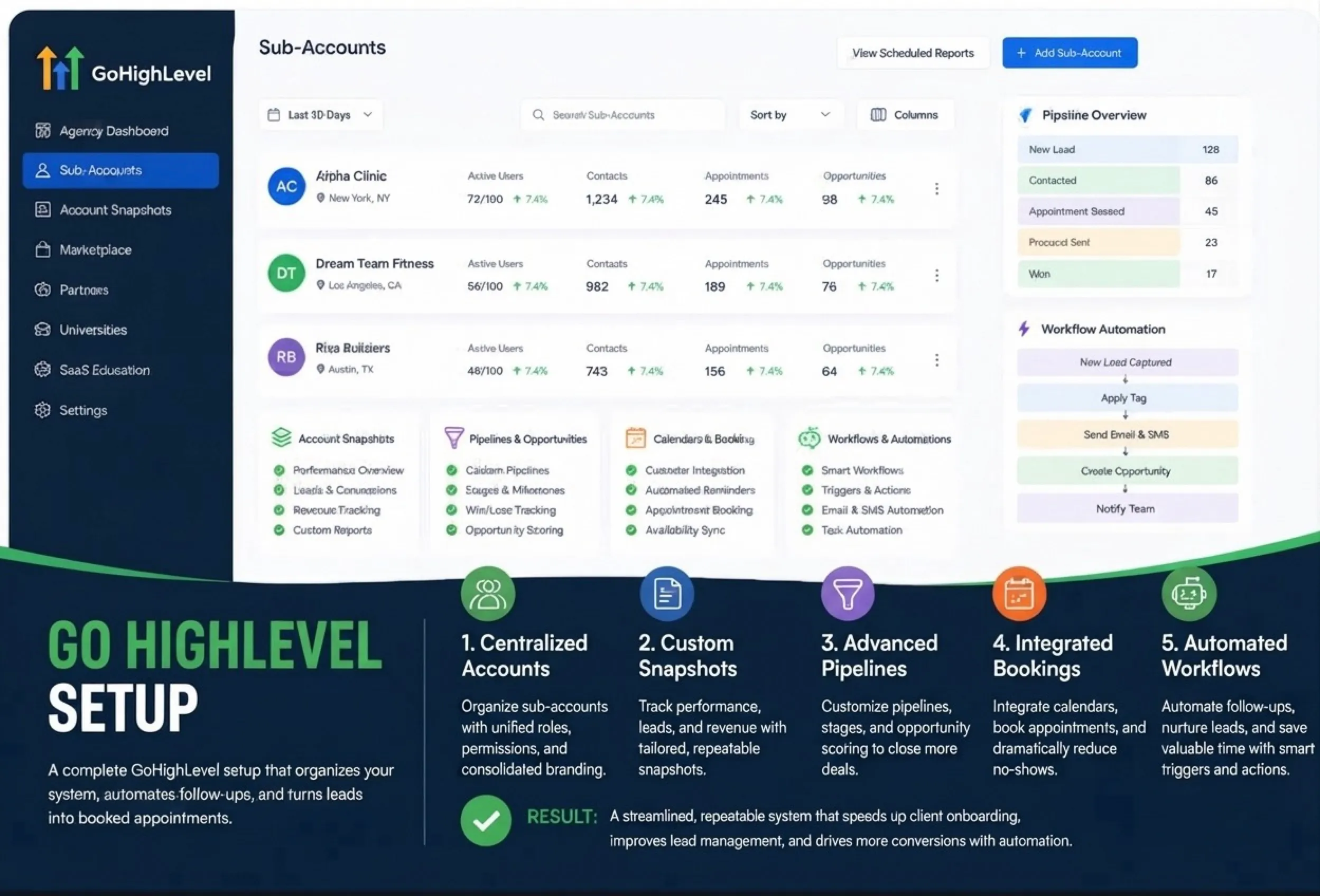
GoHighLevel CRM setup for leads, bookings and team follow-up
- Account structure, sales stages, calendars and contact data organisation
- Automated email and SMS journeys for new leads and booked appointments
- User access, tags, custom fields, task alerts and conversion tracking

GoHighLevel SaaS snapshot template for a marketing company
- A sales funnel and landing pages designed in Figma and built in GoHighLevel
- Automated workflows for capturing and converting leads
- Packaged as a snapshot so the agency can clone it for every new client
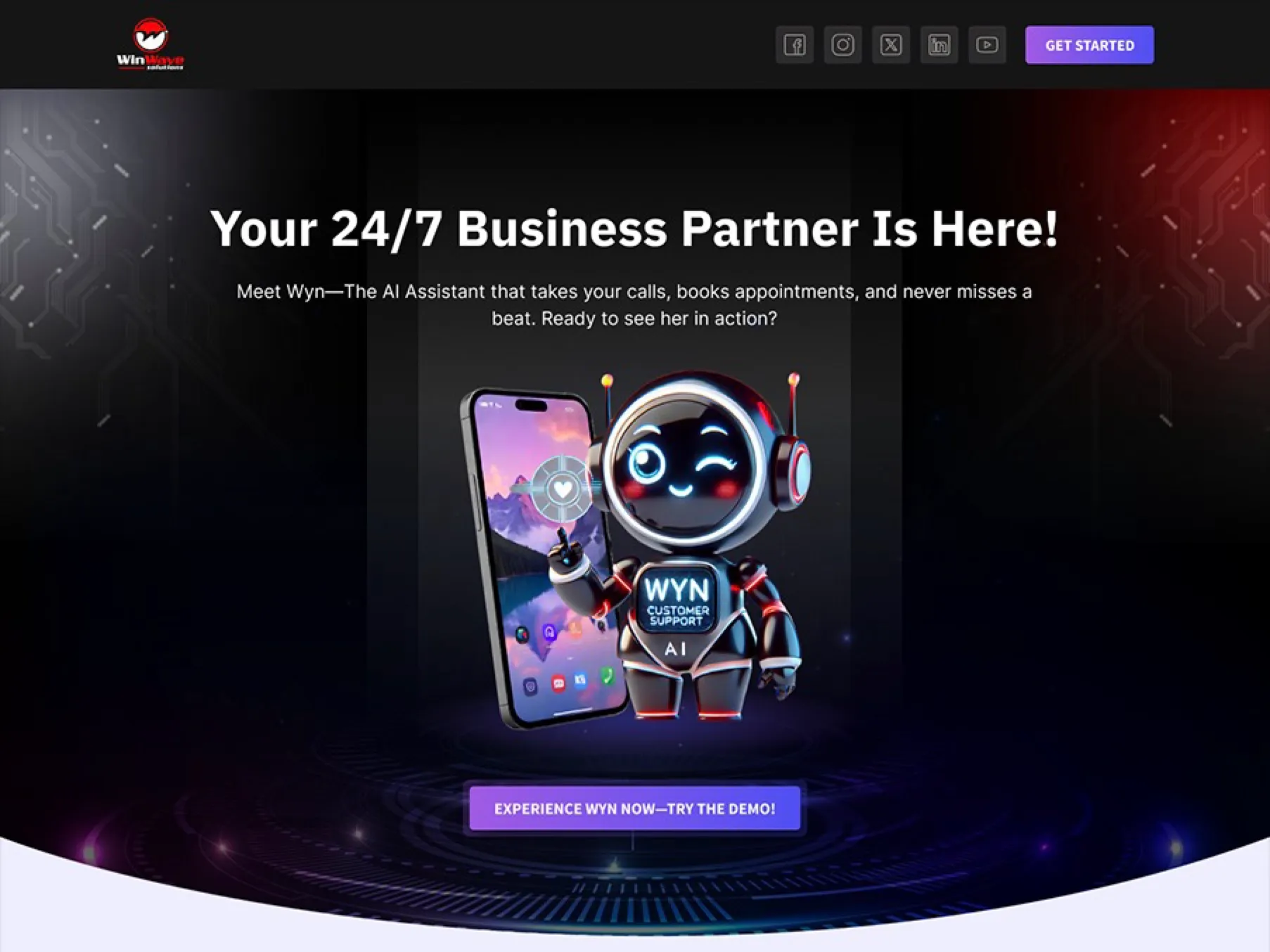
Webinar funnel in GoHighLevel with automation and Facebook ads
- Designed and built the webinar registration, confirmation and replay pages
- Automated reminders and follow-up for registrants
- Created targeted Facebook ad campaigns to fill the webinar