
How fast should you respond to a lead? Faster than you think
Two businesses buy the same leads at the same cost. One replies in two minutes, the other the next morning. By the time the second one calls, the lead has already spoken to somebody else.
Your ads are fine. Your cost per lead is fine. The leads come in, somebody gets to them when they can, and about one in twenty turns into a booking, so you go looking for better creative.
The creative is not the problem. In enquiry-driven businesses the single biggest lever between a lead and a sale is how many minutes pass before somebody makes contact, and almost every business we audit is slower than it believes it is.
Why response time decides the sale
An enquiry is a moment, not a record. Somebody has a problem, they are on their phone, they have a browser with four tabs open and they are filling in forms. Three things happen while you wait:
The context disappears. Reach them in two minutes and you are continuing something they are already doing. Reach them in two hours and you are interrupting their evening to discuss a form they half remember filling.
Somebody else gets there first. Consumers in most categories enquire with several providers at once. The first business to make contact is not just early, it defines the comparison: its prices, its availability, its approach become the benchmark the others are measured against.
Trust is being inferred from your speed. A clinic that takes a day to answer an enquiry is telling the patient something about how it will handle their appointment. Nobody says this out loud, and everybody acts on it.
This matters far more in some businesses than others. If you sell property or run a clinic, where enquiries are emotive and alternatives are one search away, speed is close to the whole game. If you sell a specialist B2B service with three competitors in the country, you have more room.
What happens to a lead over time
| Time since enquiry | What the lead is doing | What you are now doing |
|---|---|---|
| Under 5 minutes | Still on your site or in the same app session | Continuing a conversation |
| 5 to 60 minutes | Comparing two or three other providers | Competing on who feels most responsive |
| 1 to 24 hours | Has spoken to someone, may have booked | Asking them to reconsider a decision |
| 1 to 3 days | Has moved on, may not recall the enquiry | Cold outreach to a warm-cost lead |
| Over 3 days | Working with whoever answered | Paying for a lead you will not convert |
The point of the table is the last column. After a day, you are no longer following up a lead, you are doing cold sales on something you paid lead-generation prices for.
Where the delay actually comes from
In the audits we run, it is almost never that someone could not be bothered. It is structural, and there are four usual causes:
- The lead sits in a platform. Meta Lead Ads collects it and nobody has connected it to anything. Somebody logs into Ads Manager on Thursday and exports a CSV. Your two-minute window closed on Monday.
- Nobody owns it. The enquiry lands in a shared inbox or a WhatsApp group, three people see it, each assumes another has it, and it ages in plain sight.
- There is no routing rule. No rule for who takes the next lead, what happens when they are with a client, or how long before it reassigns. “Whoever is free” is not a rule.
- Office hours do not match enquiry hours. A large share of consumer enquiries arrive in the evening and at weekends, which is exactly when the business is shut and the ads are still running.
Check your own numbers before you believe any of this. Export the last hundred leads with their creation time and the time of first outbound contact, and take the median. Businesses that assume “about fifteen minutes” routinely find four hours and a tail of leads never contacted at all.
The fixes, in order
1. An instant auto-reply that does something
The cheapest fix and the one most often skipped. Within seconds of the form submission, send an email and an SMS or WhatsApp message that does four things: names your business, repeats what they enquired about, says exactly when a human will be in touch, and gives them something to do now, usually a booking link or one question to answer.
What does not work is “Thanks for your enquiry, we will be in touch soon.” It is an admission that nothing is happening yet.
2. Routing and ownership
Every lead gets an owner within one minute, by rule, not by goodwill. Round-robin across available staff, reassign automatically if there is no logged activity in ten minutes, and escalate at thirty. The owner gets a task and a notification on their phone, not an email they will see tomorrow.
This is a CRM job, and the platform matters less than whether the rules exist. GoHighLevel suits most service businesses, HubSpot suits larger sales teams, and we have written up how we choose between them. A core setup with pipelines, calendars and the first workflows usually takes one to two weeks.
3. WhatsApp or SMS before email
Reply on the channel the enquiry came from. Somebody who filled a Meta lead form on their phone will see a WhatsApp message within minutes and may never open the email. Keep email for quotes, documents and confirmations.
Two practical notes: use the WhatsApp Business API rather than someone’s personal phone, so conversations live in the CRM and survive that person leaving, and keep the first message to two sentences with one question in it.
4. An AI bot that qualifies and books
Once speed is handled, the next bottleneck is that a fast reply still needs a human to qualify. A bot trained on your services, prices and availability can answer the common questions, ask the three or four things your team needs to know, and put a booking on the calendar, at midnight, on a Sunday.
The design detail that decides whether it works: one question at a time, answers to the questions it is asked, and a clean hand-off to a person the moment the conversation needs one. Long forms lose people at every field. A conversation does not feel like a form, which is why completion rates move so much.
5. Reminders that stop a booked lead from no-showing
Speed is wasted if a third of the bookings do not show up. Confirm immediately with the time, the address or the video link and a one-tap way to reschedule. Remind 24 hours before, remind again two hours before on the channel they used, and ask once after a no-show rather than writing the lead off. We have covered the mechanics of this in WhatsApp automation for no-shows.
What this looks like when we do it
For a therapy practice, a long web intake form was losing most visitors before the end. We built a conversational bot that asks one question at a time, uses AI to detect intent and match the enquirer to the right therapist, shows insurance options and captures location, then routes the case for staff and into the CRM. Intake form completion tripled against the old form, qualified leads booking a session rose 40%, and median qualification time came in under two minutes.
The other half of the job is the system behind it. On a GoHighLevel CRM build we set up the account structure, sales stages, calendars and contact data, then automated email and SMS journeys for new leads and booked appointments, with task alerts and conversion tracking. Nothing clever, just a system where no lead waits for somebody to notice it.
What to measure, and what to decide
Four numbers, reviewed weekly:
- Median time to first response, by source and by hour of day. Medians, not averages.
- Percentage of leads contacted within five minutes.
- Percentage never contacted at all. This is usually the one that causes a change of plan.
- Booking rate and show-up rate by owner, which tells you whether the problem is speed or the conversation after it.
Run the export, take the median, and compare it with what you assumed. If the gap is hours, you do not have a creative problem or a lead-quality problem, you have a plumbing problem, and it is cheaper to fix than a new campaign.
That is what our CRM and sales funnel work is for: routing, ownership, follow-up and the reporting that shows response time by source. Or take the free audit, where a strategist looks at how your leads are handled today and leaves you a one-page plan whether you work with us or not.
Common questions
How fast should you respond to a new lead?
Inside five minutes while the enquiry is still in front of them, and ideally inside one. The useful target is not an average but a median first response under five minutes across every hour you advertise, including evenings and weekends, which is when a large share of consumer enquiries arrive.
What happens if you wait an hour to call a lead?
Two things. The context is gone, so you are explaining who you are rather than continuing a conversation, and in most consumer categories the lead has already enquired with two or three competitors. The first business to make contact sets the terms of the comparison.
Does an automated reply count as responding to a lead?
It counts as holding the position, not as the response. An instant auto-reply that names your business, says when a human will call and offers a booking link keeps the lead warm. It does not replace the human follow-up, and a generic thank-you message with no next step achieves nothing.
Should I use WhatsApp or SMS instead of email for new leads?
For consumer enquiries, yes. Reply on the channel the enquiry came from, and when that is a form or a Meta lead ad, WhatsApp or SMS gets read far faster than email. Keep email for documents and confirmations rather than for first contact.
Can an AI chatbot qualify leads without annoying them?
It can when it asks one question at a time, answers the questions it is asked, and hands over to a person the moment the conversation needs one. For a therapy practice we built an intake bot that tripled form completion against the old web form, because a conversation is easier to finish than a long form.
Proof from our work
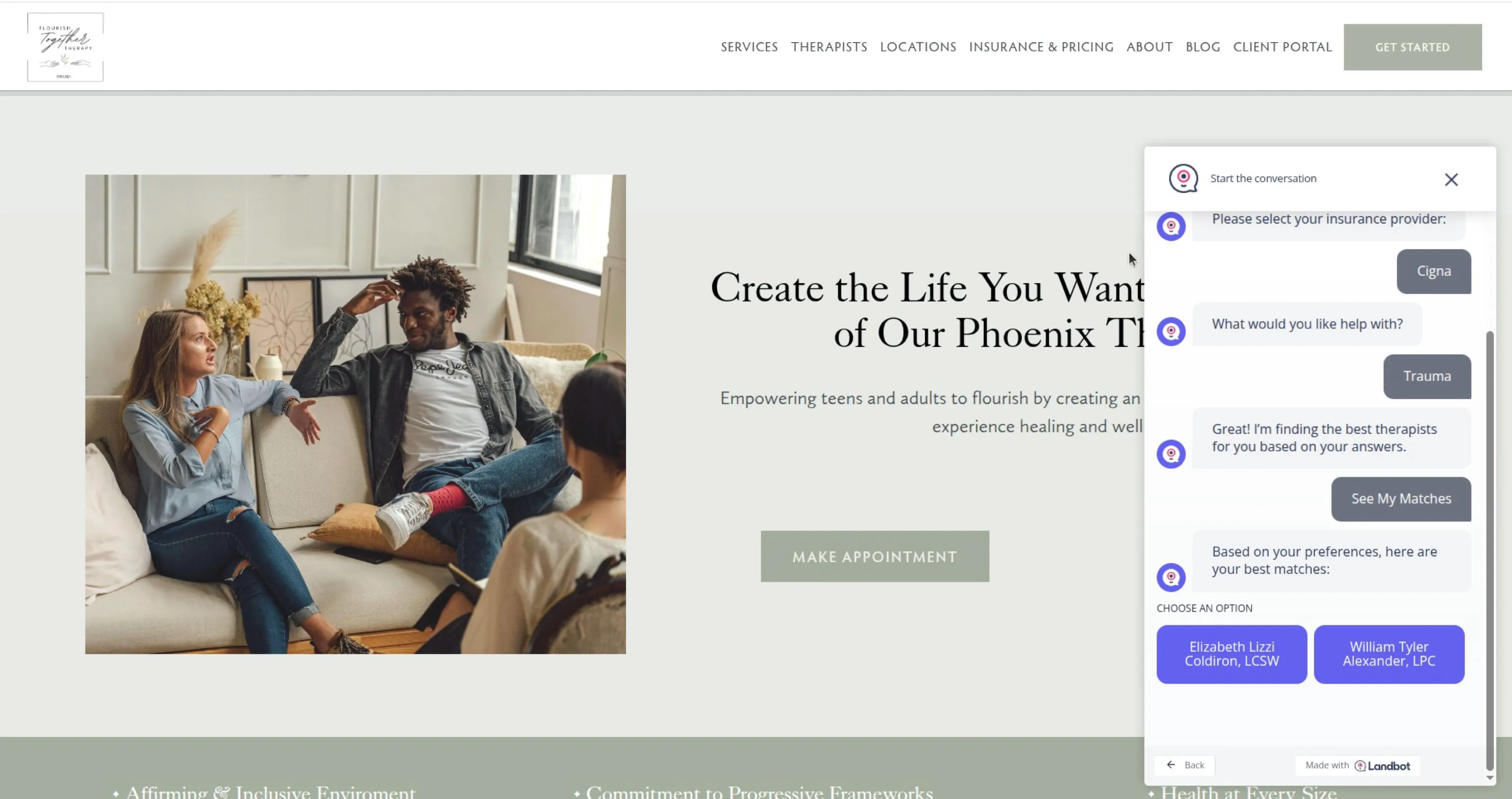
Intake form completion vs the old form
A conversational chatbot for a therapy practice that qualifies prospective clients, matches them to the right therapist, shows insurance options and captures location in a friendly chat flow. Intake completion tripled.
Read case study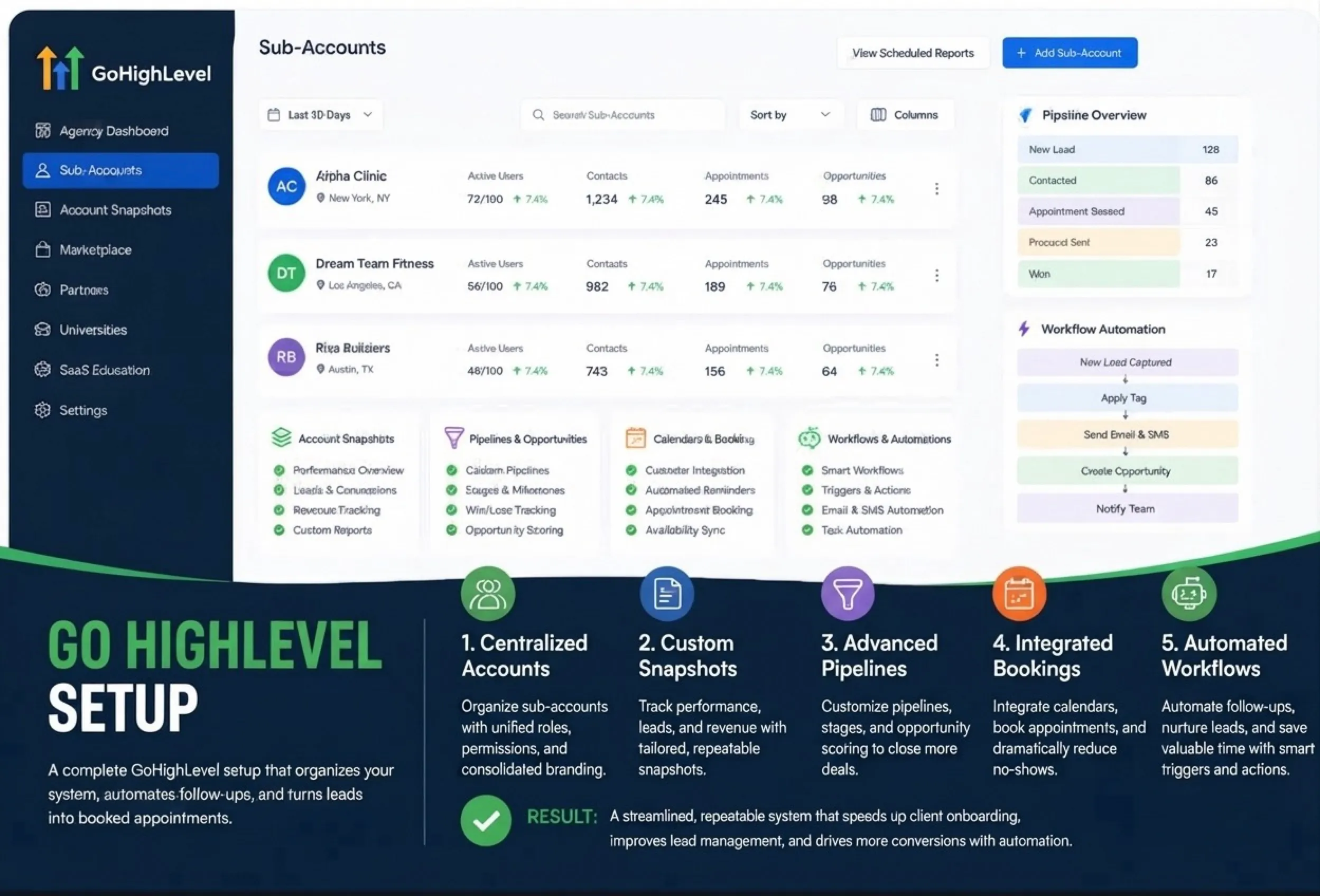
GoHighLevel CRM setup for leads, bookings and team follow-up
- Account structure, sales stages, calendars and contact data organisation
- Automated email and SMS journeys for new leads and booked appointments
- User access, tags, custom fields, task alerts and conversion tracking
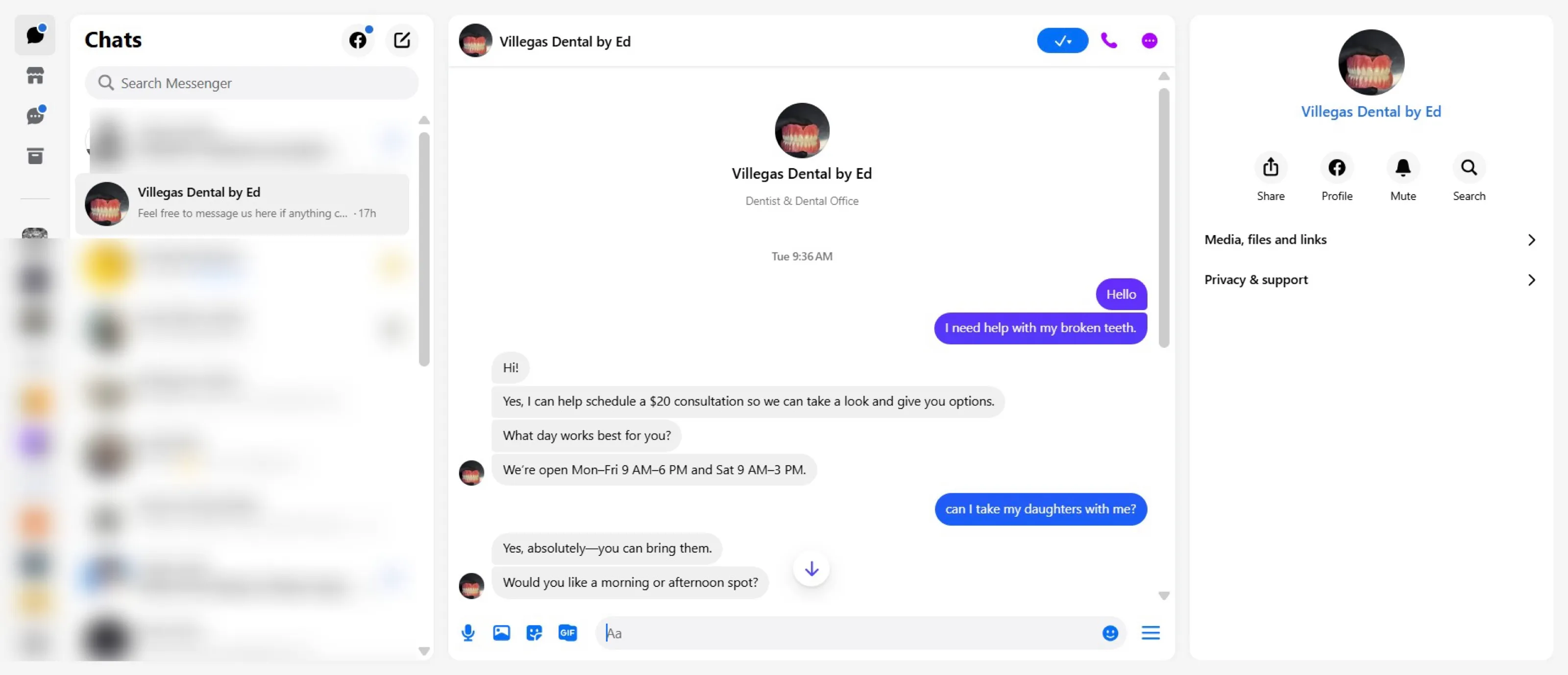
Bookings taken with no staff involvement
An AI chatbot for dental clinics that books appointments on its own: it answers instantly on Messenger, guides the patient through a natural conversation, checks availability and confirms the slot. Bookings sync to Google Calendar and Google Sheets in real time, so patients can book outside clinic hours and the front desk sees everything.
Read case study