
In-house media buyer, freelancer, agency or embedded specialist
The choice is usually framed as hire or outsource. There are four real options, and the right one depends on your spend, your tolerance for single-person risk and who will manage the work.
Your ads are running and nobody owns them. The founder is doing it between other jobs, or an agency is doing enough to keep the lights on, or a freelancer went quiet for a fortnight. The usual advice is “hire someone”, and the usual counter is “get an agency”. Both skip the actual question, which is how much of the work there is and who will manage it.
There are four options, not two
Hire in-house. A salaried media buyer who sits in your team, in your tools, in your standups.
Engage a freelancer. Usually part-time, paid monthly or hourly, working across several clients.
Retain an agency. A team on a monthly fee: a buyer plus design, video, tracking and reporting around them.
Embed a specialist. A trained media buyer from an existing team who works your hours inside your accounts, invoiced monthly, managed day to day by you but backed by their team lead. This is what our staffing model provides, and it sits deliberately between the freelancer and the agency.
They fail in different ways, which is more useful to know than their headline prices.
What an in-house hire actually costs
Do not compare a salary with a retainer. Compare total cost of employment with a retainer. Price these lines in your own market and currency before you decide:
- Base salary, plus any bonus or commission.
- Employer taxes, pension and statutory benefits.
- Recruitment: agency fee or your own time advertising, screening and interviewing.
- Equipment, desk and software seats.
- Tooling the role needs, which the buyer will ask for in week two: competitive research, creative tools, a reporting layer, an AI video subscription.
- The ramp. Expect four to eight weeks before someone is genuinely making good decisions in an account they have never seen, and one to three months before that to find them at all.
- Your management time, every week, for the life of the role.
Line 7 is the one people forget. A media buyer with nobody competent reviewing their work is an expensive way to find out in month five that the account has been optimising towards the wrong conversion event all along.
In-house is the right answer when the work is genuinely full-time, you have the budget scale to justify it, and someone in your business can judge the quality of paid media decisions. If you cannot tell a good account structure from a bad one, hiring your first buyer as your only buyer is a gamble.
Where a freelancer works, and where they break
A freelancer is the fastest, cheapest way to get competent hands on an account. For a single platform at modest spend, with a founder who knows roughly what good looks like, it is often the correct choice and we say so.
The break points are predictable. One person covers campaign management but rarely also creative production, landing pages and server-side tracking, so you end up buying three freelancers and coordinating them yourself. There is no cover: holiday, illness or a better-paying client and your account runs unattended. And there is nobody above them. When a freelancer’s judgement is wrong, there is no second opinion inside the arrangement.
If you go this route, insist on account ownership in your name, a shared reporting dashboard you can open without them, and written documentation of the account structure. Those three things turn a dependency into a relationship you can exit.
What an agency retainer buys, and when it is the wrong answer
A retainer is really a way of buying breadth you cannot hire for at one salary. A buyer, a designer, a video editor and someone who understands the Conversions API are four different people. An agency gives you a slice of each, plus accountability that does not evaporate when one person is away, plus pattern recognition from other accounts.
Where it is genuinely the wrong answer:
- Your spend is too small. We will not take on paid media below about $1,000 a month in ad spend, because there is not enough data to optimise and the fee swamps the budget. At that level, put the money into tracking, a landing page or automation first.
- The bottleneck is not the ads. If your offer, pricing or product page is the problem, better campaign management will only buy you the same losses more efficiently.
- You need someone in the room. Complex internal approvals, daily sales coordination, or a brand voice that has to be negotiated live each week are poorly served by anyone outside your team.
- You already have a good lead. If someone in-house is making the strategic calls well, you need hands and specialists, not another strategy layer.
- It is one job. A tracking rebuild or a funnel build is a project. Buy it as a project.
An agency is worth it when you want outcomes rather than hours, when the work spans ads, creative, tracking and pages at once, and when you would rather manage one relationship than four people.
The embedded specialist
The fourth option exists because the first three leave an obvious gap: people who want a buyer’s full attention on their account, in their own tools, without recruiting, payroll or a long contract.
A specialist from our team joins your Slack, your Ads Manager and your weekly meetings, working your hours. We handle their salary, equipment, office and HR, and send one invoice. A shortlist of two to three profiles with work samples comes back within 48 hours, the first week is a trial, and brief to onboarded is about seven days. If the fit is wrong we replace them at no cost. Engagements are month to month with 30 days notice, and everything they produce is yours.
Being fair about the limits: it is still one person, so a very broad remit will stretch them. They work Pakistan-based hours shifted to your timezone, which gives most UK and Gulf clients a full working-day overlap and US clients a partial one. They are backed by a team lead, but you still set priorities, which means you still need to know what you want done. And for a genuinely strategic rebuild, a team engagement will get there faster than one embedded pair of hands.
Compare them on what actually differs
| In-house hire | Freelancer | Agency retainer | Embedded specialist | |
|---|---|---|---|---|
| Total monthly cost | Salary, taxes, benefits, equipment, tools | Lowest, hourly or part-time | One fee covering a team | One monthly retainer, no payroll |
| Time to productive | 1–3 months to hire, then 4–8 weeks to ramp | Days | Tracking and first campaigns live in 14 days | About 7 days from brief |
| Breadth of skill | One skill set | One skill set | Buyer, designer, editor, tracking, CRO | One skill set, team lead behind it |
| Single-person risk | High: no cover for holiday or exit | Highest: no cover and no notice | Low: covered internally | Low: free replacement, usually within a week |
| Tooling and licences | You buy all of them | Theirs or yours, usually unclear | Included | Included |
| Management overhead | You manage and appraise | You manage and chase | One account contact | You direct, team lead supervises |
| Contract | Employment contract | Varies, often informal | 3 months, then monthly, 30 days notice | Monthly, 30 days notice |
Five questions that settle it
- How much do you spend a month? Under $1,000 in ad spend, fix tracking and pages first. Under roughly a part-time workload, do not hire full-time.
- Can someone in your business judge the work? If no, buy supervision as well as hands: an agency or a supervised specialist, not a lone hire.
- What happens if this person disappears on Friday? If the answer is “spend keeps running unwatched”, you are buying concentration risk, so price cover in.
- How many skills does the plan need? Count them honestly. Ads, creative, video, landing pages and tracking is five, and creative volume alone is now most of the job, as how AI UGC ads get made shows.
- Is the real constraint the ads? Check your break-even first. Working out a good ROAS for your margin will often show that the campaigns were never the problem.
Whatever you decide, keep the ad accounts, Pixel, audiences, CRM and data in your own name. We insist on it with our own clients, and it is the single cheapest insurance policy in marketing.
What this looks like when we do it
Most of our clients start with a team engagement and some move to embedded staff once their own processes are stable, or run both. The team model is what sat behind scaling an apparel account to a $26.8K daily budget at 389% blended ROAS and managing $729K of Meta spend for a US healthcare provider; the staffing model is what clients use when they want that capability sitting inside their own team, under their own direction.
Where that leaves you
Add up the real cost of the hire you are considering, including the months before it pays for itself, and compare it against a retainer and against an embedded specialist for the same period. If the honest answer is in-house, hire well and do not skimp on supervision. If you want to see what the embedded route would cost and who you would get, the staffing page explains the process and the shortlist arrives in 48 hours. If you are not yet sure whether the problem is the people or the accounts, take the free audit first: a strategist reviews what you have, and you keep the one-page plan whether you hire anyone or not.
Common questions
Is it cheaper to hire a media buyer or use an agency?
At low spend, an agency or a shared specialist is almost always cheaper, because one salary plus tools costs more than a retainer. Once you spend enough that a full-time buyer is busy every day and you have someone senior to manage them, in-house becomes cheaper per hour and gives you more control.
How long does it take to hire a media buyer?
Budget one to three months from writing the brief to a productive start: advertising, shortlisting, interviews, a notice period, then onboarding. Agencies and embedded specialists start in days, which matters most when your campaigns are live and losing money right now.
What is the biggest risk of a single in-house media buyer?
Concentration. One person holds the account history, the creative pipeline and the tracking knowledge, and when they are ill, on holiday or resign, spend keeps running with nobody watching it. Mitigate it with documentation, a second person with account access and a standing weekly review.
When is an agency the wrong choice?
When your ad spend is too small to justify a retainer, when the real bottleneck is your offer or your website rather than campaign management, when the work needs someone sitting in your daily standups, or when you already have a strong in-house lead and only need extra hands.
Proof from our work
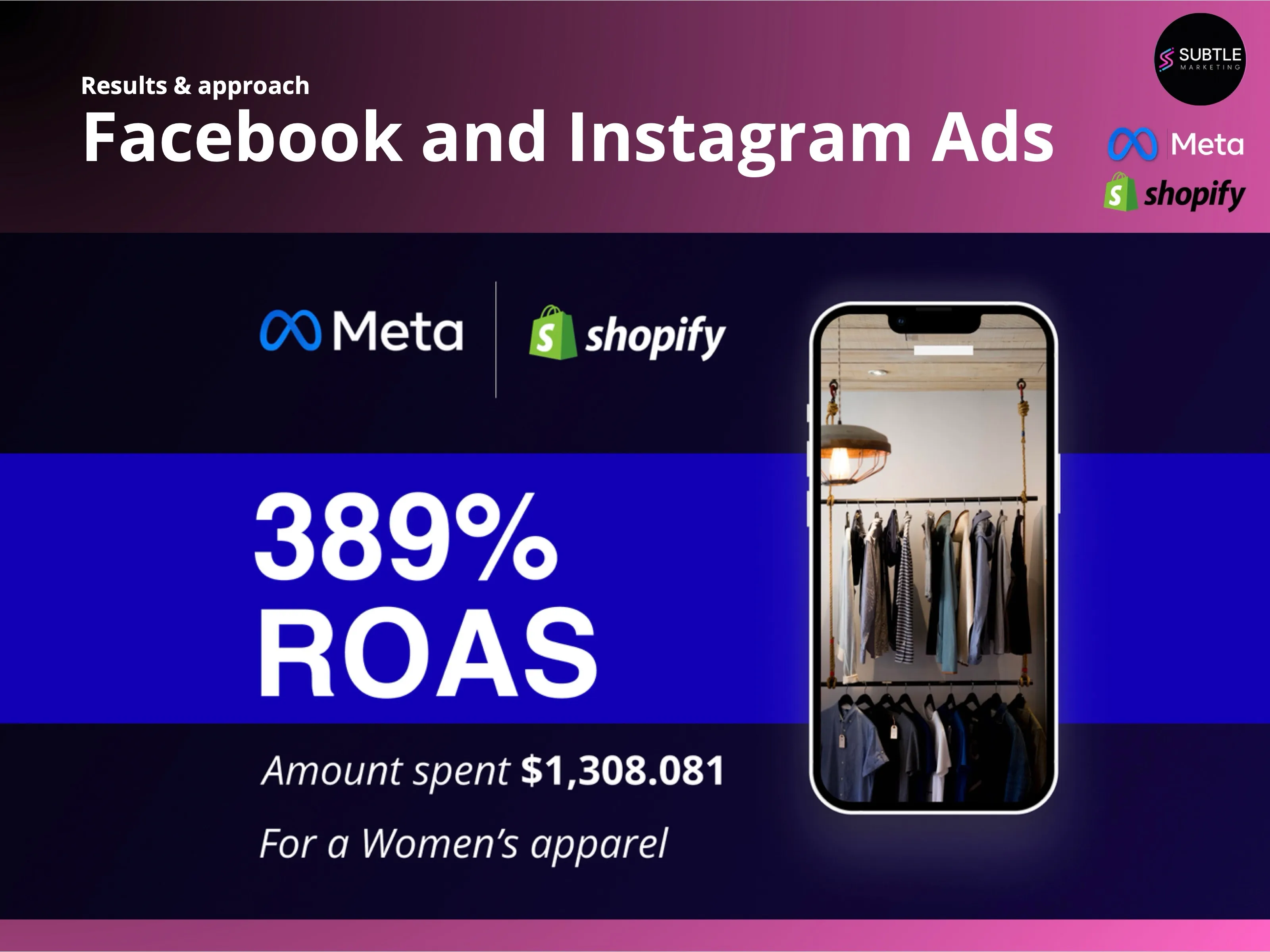
Blended return on ad spend
A Shopify women's apparel brand came to us with a 42% higher cost per conversion than target and campaigns that would not scale. Six months later the account was spending $26,849 a day at a 389% blended ROAS.
Read case study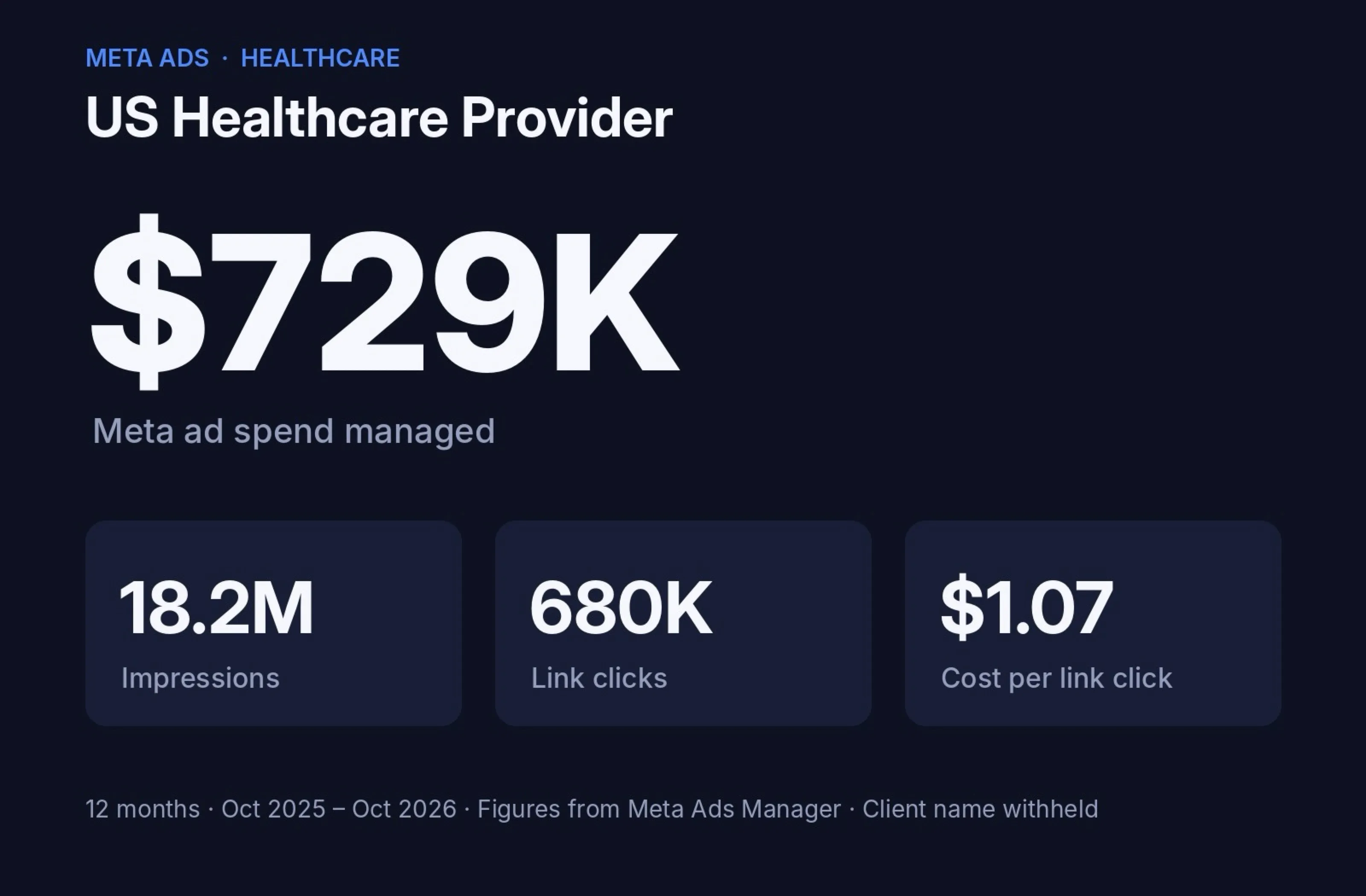
Meta ad spend managed in 12 months at $1.07 per link click
A US healthcare provider needed steady patient demand at scale without traffic costs creeping up. Across two ad accounts and twelve months we managed $728,794 of Meta spend, delivering 680K link clicks at $1.07 each and a 3.7% click-through rate.
Read case study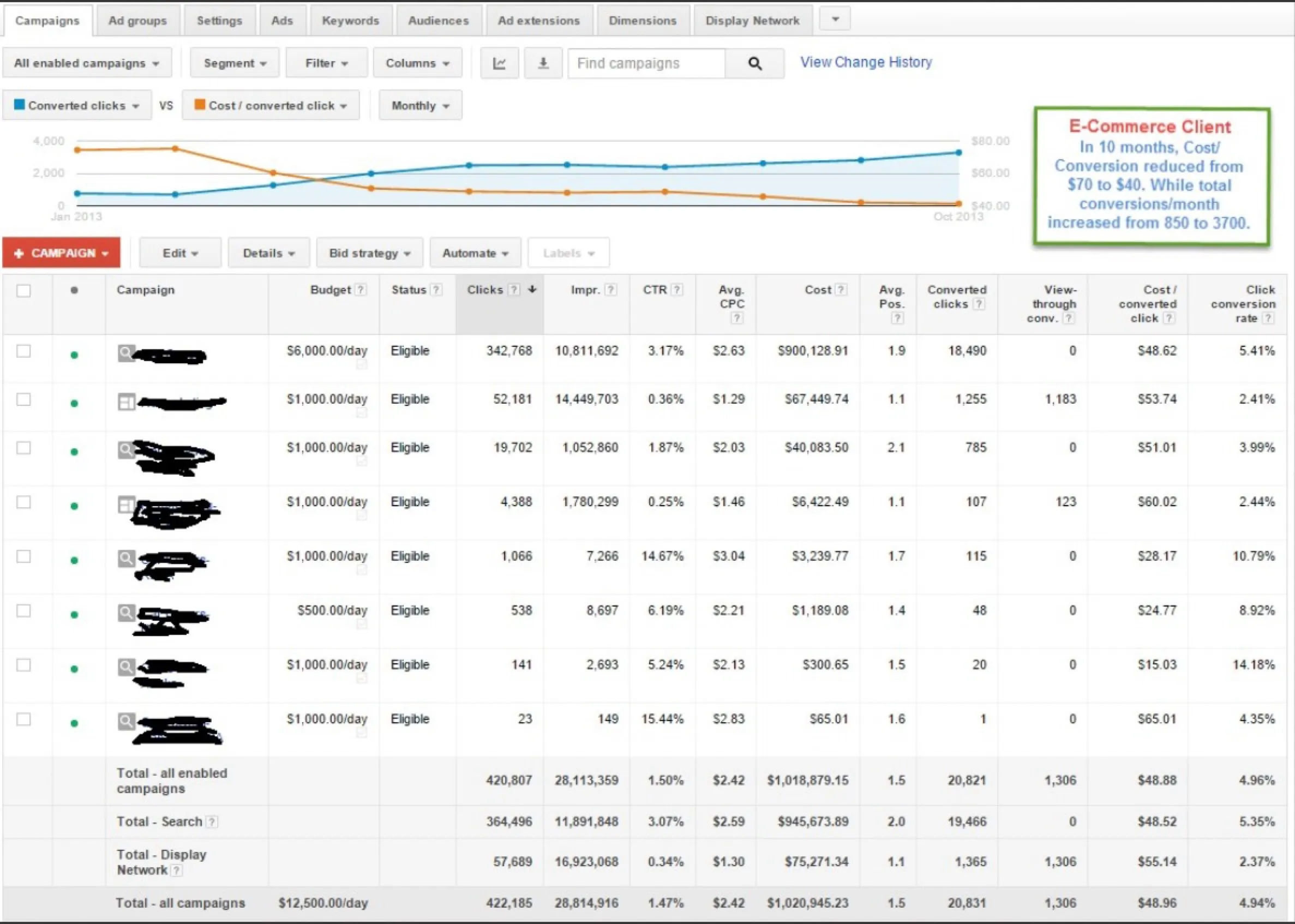
Increase in order throughput
The client wanted lower unit costs and more overall volume. Thousands of negative terms, systematic ad copy tests and several bid strategy tests produced a large drop in unit cost and a four-fold increase in throughput.
Read case study