
How long SEO takes to work, month by month
Eight weeks in, rankings have twitched and traffic has not moved, and someone in the meeting is asking whether this is working. Here is what should be happening when.
You signed off the SEO work eight weeks ago. A few rankings have twitched, traffic looks the same as it did in March, and somebody on the call is asking whether this is actually working. It is a fair question. It is also answerable, but only if you know which numbers are supposed to move in week six and which ones are not supposed to move until month five.
Our position has not changed across 100+ SEO projects: SEO takes three to six months to produce traffic you can build a forecast on. We will not promise faster, and when an agency does, it is usually because they are about to report on a branded keyword you already owned.
Months 1 and 2: you are buying coverage, not rankings
The first eight weeks are spent on things that do not look like marketing. Crawl the site, find out how many pages Google actually has in its index versus how many you think it has, fix the template-level problems, and get the content out of the door.
Typical work in this window:
- Resolve indexing blocks:
noindexleft on a staging template, arobots.txtrule blocking a whole directory, canonical tags pointing at the wrong URL. - Fix internal linking so that money pages are not four clicks from the homepage.
- Clean duplicate URLs created by filters, sorting parameters and session IDs.
- Ship the first batch of content, which will not rank for weeks because it has not been crawled, linked or aged.
What you should see by the end of month two: more pages in Search Console’s Pages > Indexed report, higher daily crawl requests in Settings > Crawl stats, a rising count of queries where you appear at all, and total impressions trending up. Clicks will be close to flat. That is the correct outcome, not a bad one.
Months 3 and 4: the long tail starts paying
This is where the work stops being invisible. Long-tail queries — the four and five word phrases with low volume and clear intent — begin landing in the top ten. They convert well and they are the first real traffic you get.
Average position improves on the pages you touched in month one. Impressions keep climbing, and now a share of them become clicks. If you are an e-commerce brand, the first organic revenue usually shows here, and it usually comes from product and collection pages rather than blog posts. If you have thin collection copy and messy faceted URLs, this is the month that becomes obvious, which is why we treat Shopify collection page SEO as its own workstream rather than an afterthought.
Expect the head terms — the two-word, high-volume phrases your competitors have held for years — to still be nowhere. They are not the month-four prize.
Months 5 and 6: compounding, and the first honest review
By month five the pages published in month one have aged, accumulated internal links and started earning external ones. Rankings move in clusters rather than one at a time, because authority built on one page lifts the pages it links to.
Month six is the right time for a hard review. The question is not “are we number one yet”. It is: is the trend line in Search Console compounding, or is it a flat line with noise on it? Compounding means keep going. Flat after six months of genuine execution means the strategy was wrong — usually the keywords were too competitive for the site’s authority, or the content answered a question the buyer was not asking.
Month 6 and beyond: where the economics change
After month six the cost structure inverts. Your SEO spend is roughly fixed while the traffic keeps growing, so cost per visitor falls every month. Head terms come into range. The work shifts from fixing and publishing to refreshing, consolidating and earning links.
We do not recommend cutting paid spend at this point. Run both until organic revenue is steady and attributed, and reallocate from the paid side once you have two or three clean months of data.
What changes the timeline
| Factor | Pulls the timeline in | Pushes it out |
|---|---|---|
| Domain age | 2+ years with existing rankings and referring domains | Registered this year, no history, no links |
| Competition | Niche terms, few optimised competitors | National terms held by established brands with large content teams |
| Existing content | Hundreds of indexed pages to refresh and consolidate | Ten pages, all of them service pages |
| Technical debt | Obvious, template-level, fixable once and applied everywhere | Platform limits, a headless build nobody can safely change, a migration that lost redirects |
| Link profile | Clean profile, relevant referring domains already pointing in | Toxic or bought links to disavow first, or no profile at all |
| Publishing capacity | Approvals in days, content signed off in batches | Legal review on every page, one post a month |
Two of these are worth saying plainly. A brand-new domain in a competitive niche sits at the six-month end or beyond, every time. And technical debt that cannot be fixed because of platform constraints does not get solved by publishing more content.
Leading indicators: what to check before traffic moves
Put these five numbers on a monthly sheet. They move in roughly this order, and together they tell you whether the engine is running long before the revenue arrives.
- Pages indexed — Search Console, Pages report. Should rise within weeks of fixing crawl problems. If it falls, something broke.
- Crawl requests per day — Settings > Crawl stats. A rising crawl rate on a healthy site means Google thinks there is something worth re-checking.
- Total impressions — the earliest demand signal. Rising impressions with flat clicks is positions 20-40, which is normal and temporary.
- Keywords ranking in the top 100 — coverage. New keywords entering the top 100 at all is progress; waiting for the top 10 hides it.
- Average position on your target page set — track your 20-30 commercial URLs, not every keyword. Site-wide average position is noise.
If three of those five are not moving by the end of month three, raise it. That is a strategy problem and waiting will not fix it.
Why some sites move faster
Two of our cases beat the three-to-six-month range, and both for reasons you can check against your own site rather than hope for.
DLL Files gained 55,000 monthly organic visitors in 12 weeks. It was already a global site at roughly 405,000 monthly organic visitors with 195,000 backlinks and 24,900 ranking keywords. The authority existed; the templates were holding it back. A technical pass on indexing, canonicalisation and speed applied to hundreds of thousands of pages at once, so one fix moved 1,800 keywords into the top three. A ten-page site cannot do that, because there is nothing to multiply.
A 4x increase in clicks in three months came from the same shape of problem: existing pages ranking just outside the positions that get clicks, lifted by on-page work and better internal linking rather than new content waiting to age.
The honest read on both: speed came from scale that already existed. If you do not have it, you are on the three-to-six-month path, and the right plan builds the asset rather than pretending otherwise.
What this looks like when we do it
We start with an audit, agree a target page set, and then report against the five leading indicators above every month so you are never guessing in month two. On SEO engagements the first 90 days are usually technical plus the first content batch, and we tell you at the outset which month we expect clicks to move in. Our AI search visibility work runs alongside it, because the same entity clarity and structured data help both.
The decision in front of you is not whether SEO works. It is whether your site has the authority to move in three months or needs six, and that is answerable in an afternoon by looking at your indexed footprint, your referring domains and your crawl stats. Book the free audit and a strategist will go through yours before the call. You keep the one-page plan either way.
Common questions
How long does SEO take to show results?
Three to six months for traffic you can plan around. The first two months go on technical fixes and content that search engines have not yet crawled, so you will see indexing and impression growth before clicks. Competitive niches and new domains sit at the slower end of that range.
Why is my SEO traffic flat after two months?
Flat traffic at two months is expected, not a failure. Check impressions in Google Search Console instead. If impressions are climbing and average position is improving while clicks stay flat, you are ranking on pages three and four, and those positions convert to clicks as authority builds.
Can SEO work faster than three months?
Occasionally, on established domains. A site with existing authority, a large indexed footprint and obvious technical problems can gain quickly because the fixes apply to thousands of pages at once. A new domain with ten pages cannot do this, and we will say so before you sign anything.
What should I measure in month one of an SEO campaign?
Pages indexed, crawl requests per day, Core Web Vitals pass rate, total impressions, and the number of keywords ranking anywhere in the top 100. These move first. Sessions and revenue come later and are the wrong early scorecard.
How long until SEO beats paid ads on cost per sale?
Usually somewhere between months six and twelve, because SEO cost is fixed while the traffic compounds. We do not recommend cutting paid spend before organic is delivering steady, attributed revenue. Running both while SEO matures is the lower-risk path.
Proof from our work
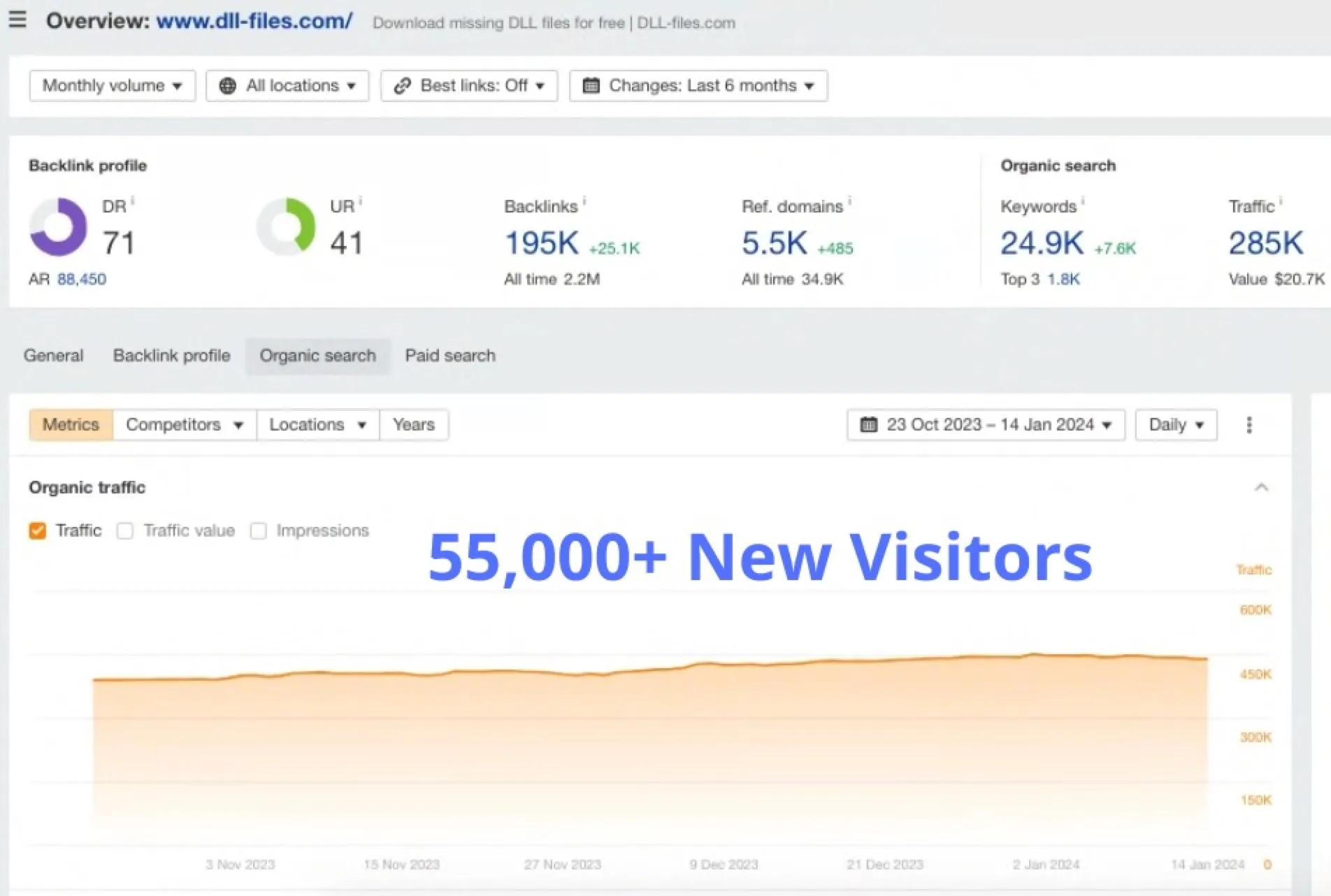
New monthly organic visitors in 12 weeks
A global software download site already had scale. In 12 weeks we added 55,000 monthly organic visitors, 7,600 new keywords and 1,800 new top-3 rankings, pushing monthly organic traffic to 285K with a traffic value of $20.7K.
Read case study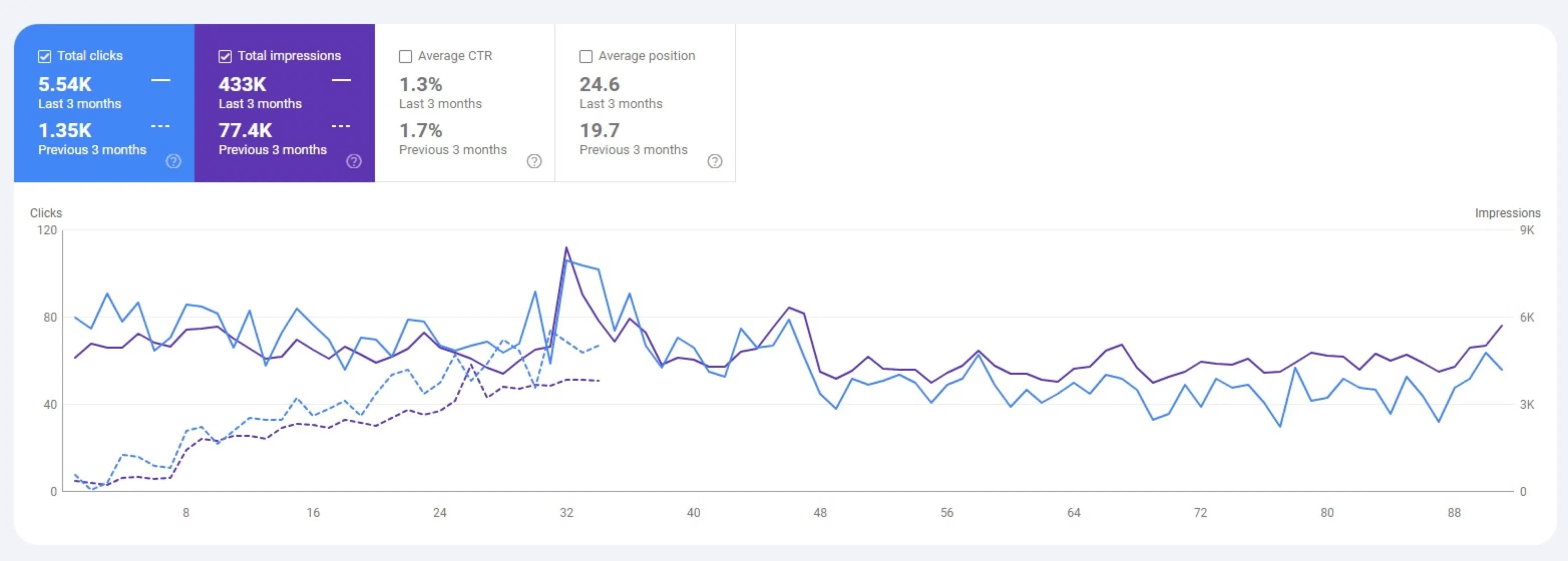
1.35K → 5.54K organic clicks in 3 months
A business wanted first-page rankings for its core terms. Starting with a full audit, we fixed the technical issues, rebuilt the key pages around search intent and earned links. In three months clicks went from 1.35K to 5.54K and impressions from 77.4K to 433K.
Read case study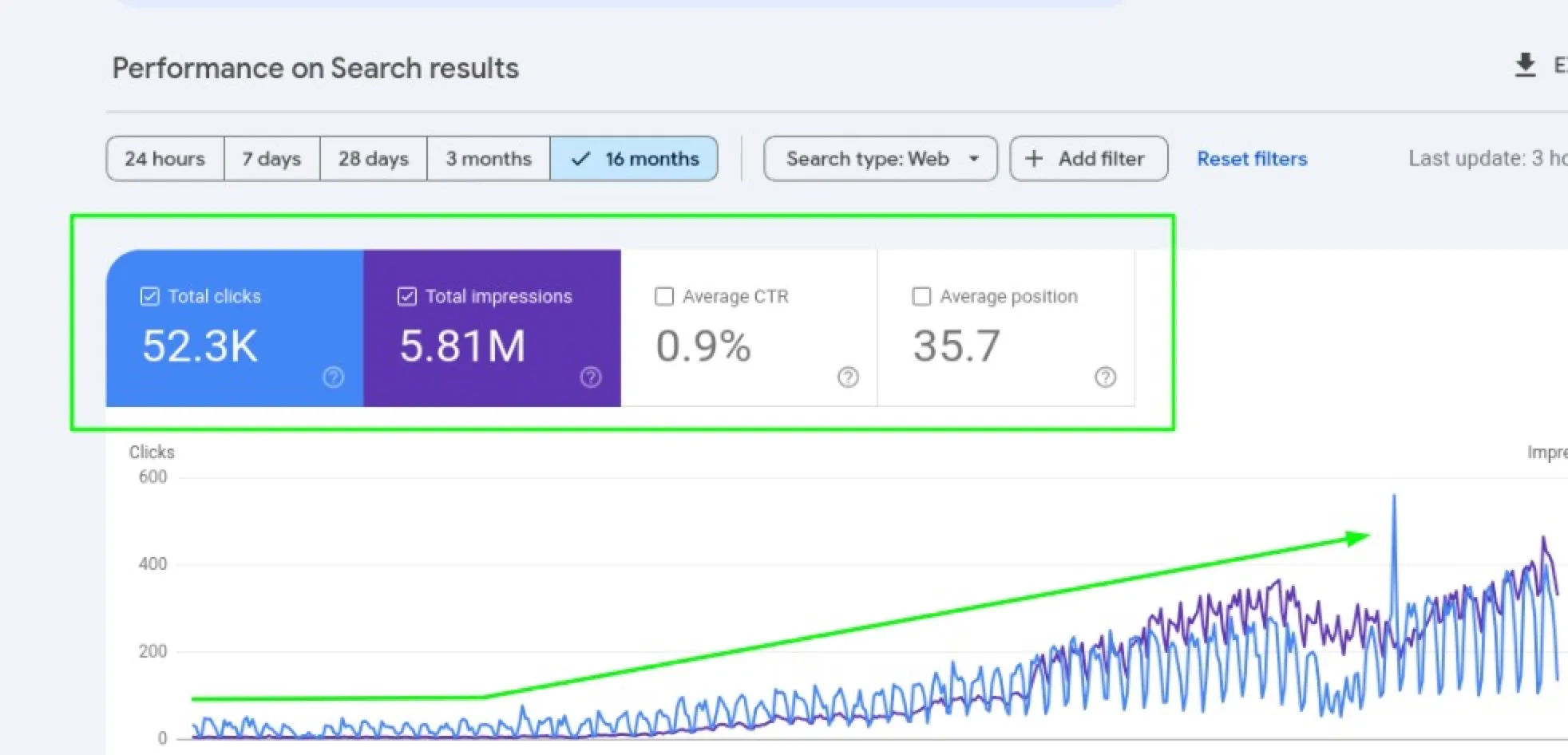
Organic clicks for a new site, 5.81M impressions
A new website with no organic history grew to 52.3K clicks and 5.81M impressions. The work combined a strong technical foundation, content built around real search opportunities, schema markup and optimisation for AI-powered search results.
Read case study