
How to get cited in AI search results
Your traffic is flat but your impressions are up, and people arrive already knowing your pricing. They read about you in an answer you cannot see. Here is how to get into it.
Your impressions are climbing, your clicks are not, and the last three enquiries arrived already knowing your pricing and your turnaround time. Nobody read that on your pricing page, because the pricing page got 11 visits last month. They read a summary of you, written by something you cannot log into.
That is the shape of the problem. The job is no longer only to rank a page; it is to be the source an answer engine reaches for. The foundations are the same ones in how long SEO takes to work — crawlable, indexed, authoritative pages — but what gets you selected on top of that is different, and it is mostly mechanical.
How answer engines choose sources
Different systems, broadly similar behaviour. Google’s AI Overviews are built over its own index. Perplexity and ChatGPT’s browsing retrieve live pages, generally via search, then summarise what they fetched. In all three cases the model is doing a retrieval step and then a selection step, and the selection step favours sources that are:
- Retrievable. Server-rendered HTML, not content that only appears after JavaScript. If your key copy is injected client-side, assume some crawlers never see it.
- Parseable. One clear claim per passage, under a heading that matches the question.
- Attributable. A named publisher, an author, a date, and markup that says so.
- Corroborated. The same facts appear about you elsewhere. A model has no way to check you except consistency across sources.
- Current. A visible, accurate last-updated date beats an undated page on identical content.
Keyword density is not on that list and has not been for years. What replaced it is extractability.
Entity clarity: be a thing the model can resolve
Before a model can cite you it has to work out who you are. That resolution is easier when your identity is stated the same way everywhere.
Practical steps:
- Put
Organizationschema on the homepage withname,url,logo,sameAs(your LinkedIn, Crunchbase, X, Companies House or equivalent) anddescription. - Write one canonical boilerplate description of the business and use it, unchanged, on the site, your profiles and any directory listing. Variations create ambiguity.
- Keep hard facts identical across the site: founding year, locations, team size, services. Conflicting numbers on two pages mean neither gets quoted.
- Add
Personschema with real author bios for anyone writing. An unattributed article is a weaker candidate than a signed one. - Make an
/about/page that reads like a reference entry rather than brand poetry. Who, where, since when, what for, for whom.
For local businesses this overlaps directly with the profile and NAP work in the local SEO checklist: the same consistency that fixes your map pack also makes you resolvable as an entity.
Write answer blocks, not essays
This is the change that matters most on the page itself, and it is cheap to make.
Every ## heading should be a question or a clearly scoped outcome. Immediately underneath it, answer in 40 to 60 words, in complete sentences, with no “as we discussed above” and no pronoun that depends on the previous paragraph. Then expand with detail, examples and caveats. A model that lifts those first 60 words should produce something accurate and quotable without rewriting.
Things that make a passage hard to quote, and therefore skippable:
| Pattern on the page | Why a model skips it | What to do instead |
|---|---|---|
| Heading, then three paragraphs of build-up | No self-contained answer to lift | Put the answer first, context after |
| “It depends on several factors” | No claim to cite | Give the ranges and name the factors |
| Answer split across a paragraph and a table | Passage is incomplete on its own | Summarise the table’s conclusion in prose above it |
| Facts only inside an image or chart | Not readable as text | Repeat the key figures in the body copy |
| Unqualified superlatives | Unverifiable, risky to repeat | Specific numbers with a stated source |
Add FAQPage schema for genuine questions, Article with datePublished and dateModified, HowTo for real step sequences, and Product with offers on commercial pages. Validate in Google’s Rich Results Test. Schema is not the thing that wins you the citation, but missing schema is a cheap reason to be passed over.
Be cited elsewhere, because corroboration is a selection signal
Models lean on sources that other sources already support. That makes off-site presence part of your on-site visibility:
- Get into the comparison and “best X for Y” listicles that already appear as citations for your category. Check which ones by running the prompts yourself and reading the source lists.
- Answer questions on the forums and communities in your niche under a real profile, usefully, with no link-dropping. These pages get retrieved often.
- Publish original data. A number only you have is the most quotable thing you can own, and it attracts the mentions that corroborate everything else.
- Keep third-party profiles accurate. Out-of-date directory entries are a common source of a model telling someone the wrong thing about you.
Measuring it when there is no rank tracker
There is no reliable position number for an AI answer. The answer varies by phrasing, by account, by session. So build a scorecard from four things instead:
- Assistant referral traffic. In GA4, look at Reports > Acquisition > Traffic acquisition, then segment session source for
chatgpt.com,perplexity.ai,copilot.microsoft.comandgemini.google.com. Volumes are usually small and the conversion rate is usually high, because the visitor arrives pre-qualified. - A manual prompt panel. Write down 20 prompts a buyer would actually type. Run them monthly in each assistant you care about, in a logged-out session, and record two columns: were you named, and were you linked. It takes 30 minutes and it is the only direct read you have.
- Search Console question queries. Filter queries containing “how”, “what”, “best” and “vs”. Rising impressions with falling click-through on those is the signature of answers being shown above you. Those are the pages to rewrite as answer blocks first.
- Branded search and direct traffic. If people are learning about you inside an assistant and then searching for you by name, this is where it shows.
Report all four monthly. Any single one of them on its own is easy to misread.
What we would not bother with
We would not buy a tool that claims to rank-track AI answers as though they were positions; the variance makes the number meaningless. We would not rewrite good long-form content into bullet soup, because thin pages do not get cited either. And we would not chase this before the basics are done: if your product pages are not indexed, or the site takes six seconds to render, answer engine optimisation is the wrong thing to be working on this quarter.
What this looks like when we do it
Our largest GEO, AEO and SEO programme has driven 21 million clicks, and the method was not exotic. Clean technical foundations, entity and structured data done properly, pages restructured so each section answers one question completely, and a sustained off-site presence so the facts about the business were corroborated wherever a model looked. The same work compounds in classic search, which is the point: you are not choosing between the two.
So the decision is narrower than it sounds. Either your pages already answer a defined question in their first 60 words, or they do not, and you can check that on your top ten URLs this afternoon. If you want the version with the prompt panel, the schema gaps and the citation targets already written down, our SEO team does that as part of the free audit — 30 minutes, and you keep the one-page plan.
Common questions
How do I get my website cited by ChatGPT or Perplexity?
Make each page easy to parse and verify. Use question-shaped headings with a direct 40 to 60 word answer underneath, add Organization, Article and FAQPage structured data, keep facts consistent across your site, and earn mentions on sources that already get cited in your niche. Crawlable, indexed pages are the baseline.
Is AEO different from SEO?
It shares the foundation and changes the target. Both need crawlable, indexed, authoritative pages. Answer engine optimisation adds extractability: self-contained answers, clear entity definitions, structured data and consistent facts, because a model is selecting a passage to quote rather than a page to rank.
How do I track whether AI search is sending me traffic?
In GA4, segment referral traffic by source for assistant domains such as chatgpt.com and perplexity.ai, and check Search Console for impression growth on question queries with low click-through. Add a monthly manual check: run 20 fixed prompts and record whether you are named.
Does structured data help with AI Overviews?
It helps indirectly and reliably. Structured data removes ambiguity about what a page is, who published it and what the facts are, which makes the content cheaper for a model to use with confidence. It is not a switch that puts you in an answer, but its absence makes you easier to skip.
Will AI search reduce my organic traffic?
For informational queries, often yes: an answer shown in the results page can satisfy the searcher without a click. Commercial and comparison queries hold up better. The practical response is to make sure you are the source being cited, and to measure branded search and direct traffic alongside organic clicks.
Proof from our work
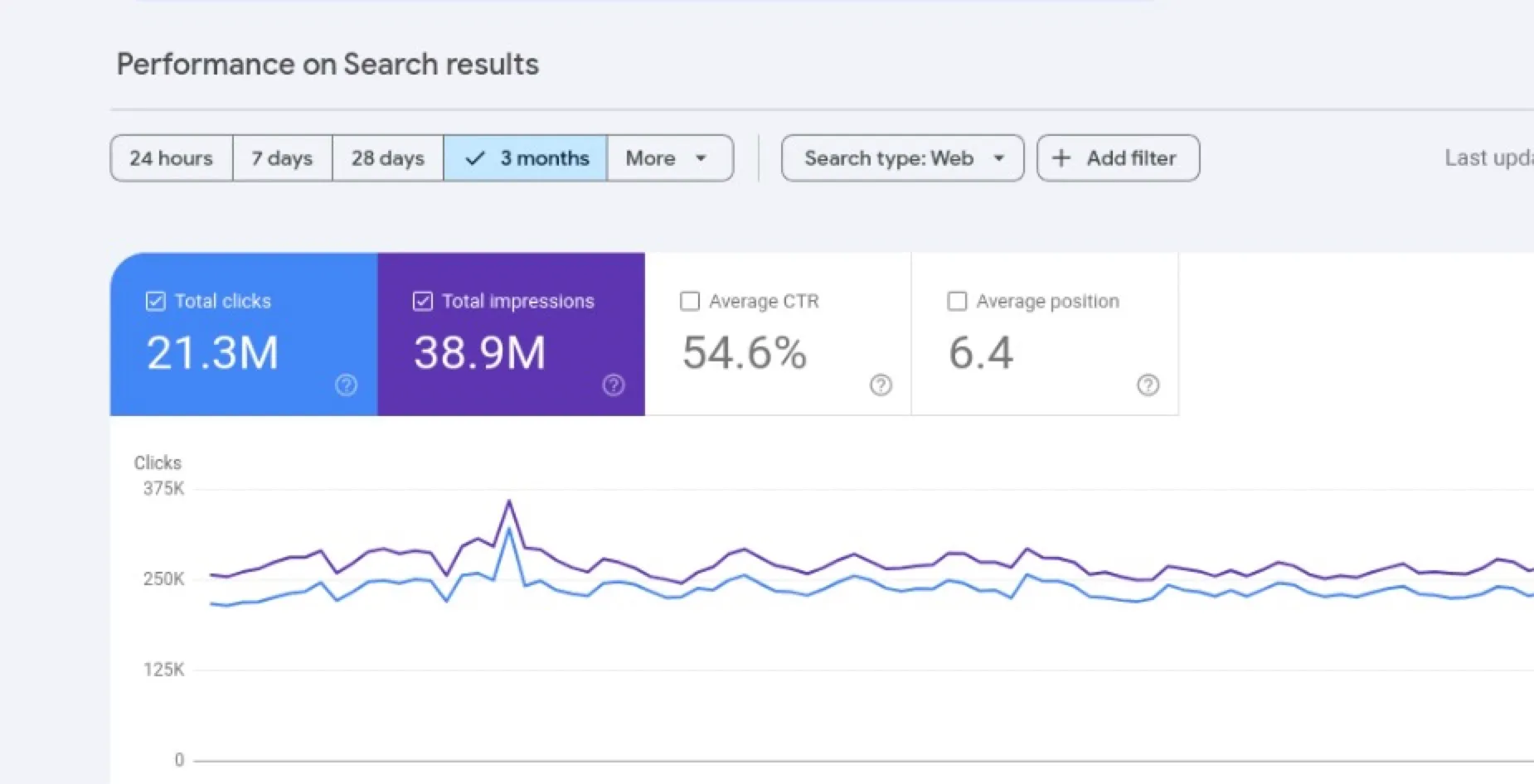
In 3 months, with 38.9M impressions and a 54.6% CTR
For a high-traffic site we combined generative engine optimisation and answer engine optimisation with classic technical and on-page work. Over three months Search Console recorded 21.3M clicks and 38.9M impressions at a 54.6% click-through rate.
Read case study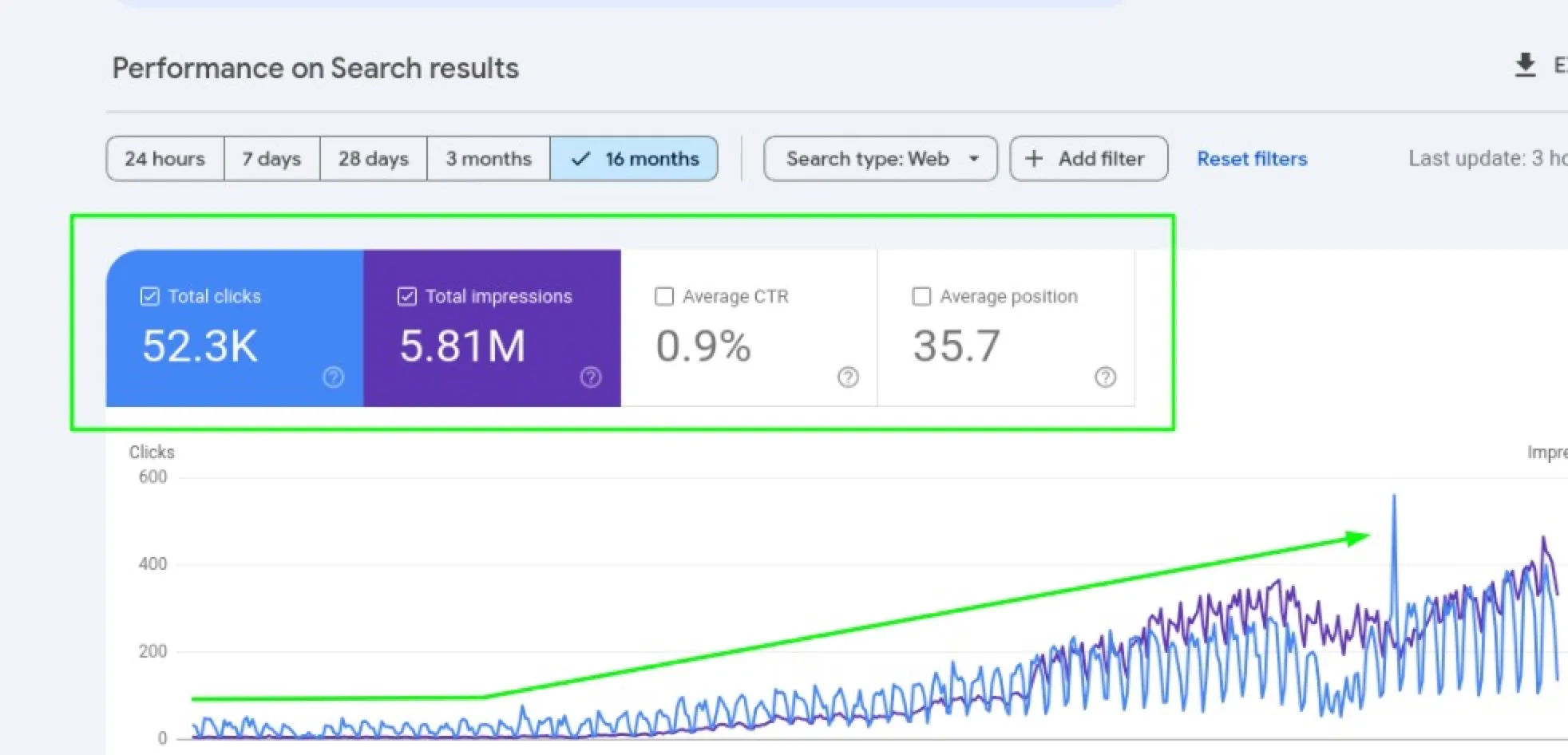
Organic clicks for a new site, 5.81M impressions
A new website with no organic history grew to 52.3K clicks and 5.81M impressions. The work combined a strong technical foundation, content built around real search opportunities, schema markup and optimisation for AI-powered search results.
Read case study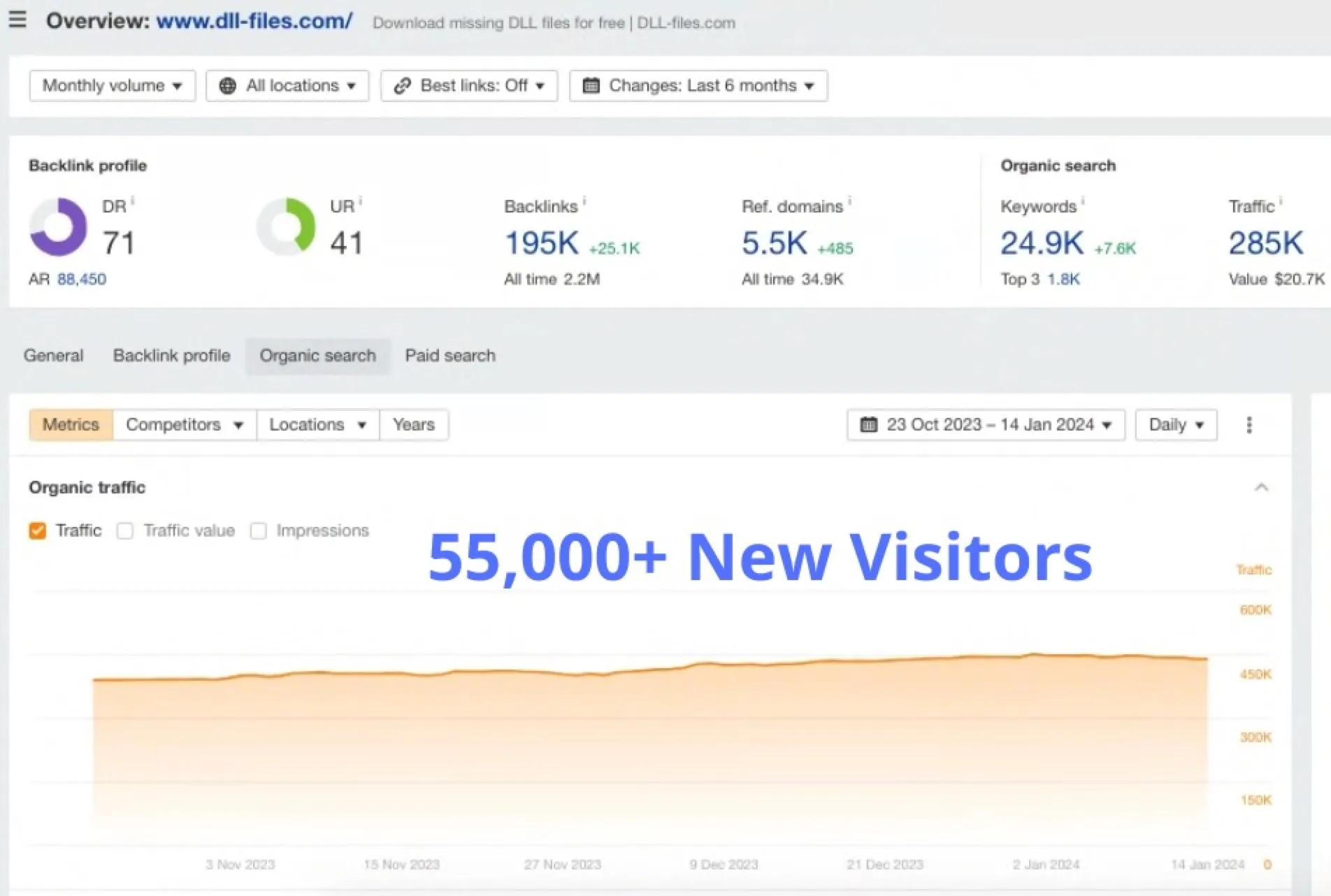
New monthly organic visitors in 12 weeks
A global software download site already had scale. In 12 weeks we added 55,000 monthly organic visitors, 7,600 new keywords and 1,800 new top-3 rankings, pushing monthly organic traffic to 285K with a traffic value of $20.7K.
Read case study