
Google Ads wasting money? Run this audit in an hour
Most accounts leak spend in the same six places. Work through them in order with a timer and you will find the waste before lunch.
The spend is real, the conversions are plausible, and the bank balance disagrees with the dashboard. In most accounts we audit, the waste is not hidden cleverly. It sits in six reports, and you can read all of them in an hour. Set a timer and work in this order, because each step changes what the next one means.
Minutes 0 to 20: read the search terms report
Go to the campaign, then Insights and reports, then Search terms. Set the date range to the last 90 days, add the conversions and cost columns, and sort by cost descending. Do not filter. Read the top 50 lines.
You are not looking for keyword ideas. You are looking for the money you did not mean to spend. Four patterns account for most of it.
| What you see | What it means | What to do |
|---|---|---|
| High-cost terms with zero conversions over 90 days | Wrong intent, usually research or a competitor’s product | Add as negatives, phrase match if it is a theme |
| Terms with “free”, “cheap”, “diy”, “jobs”, “salary”, “course” | Information seekers, not buyers | Add to a shared account-level negative list |
| Competitor and other brand names you never bid on | Broad match or close variants spreading | Negative the brand name; decide separately whether competitor bidding is a strategy |
| Your own brand name inside a non-brand campaign | Traffic you would have had anyway, now charged to ads | Move brand into its own campaign so non-brand performance is visible |
Note what share of your 90-day spend those lines represent. That number is your answer to whether this audit was worth an hour.
Minutes 20 to 30: negative lists that actually hold
Negatives added at ad group level are forgotten within a quarter. Build them once, properly, at Tools then Shared library then Negative keyword lists, and apply the list to every relevant campaign.
Three lists cover most businesses: a general junk list (free, cheap, jobs, salary, meaning, wikipedia, reddit), a not-our-business list (the services and products you do not sell but rank adjacent to), and a geography list for places you cannot serve.
Match type matters inside negatives, and it works differently from positive keywords. A negative phrase match blocks anything containing that phrase. A negative exact blocks only that exact query. Negatives also do not use close variants, so a negative for “free” does not block “freebie”. Add plurals and misspellings deliberately.
One warning. Over-negating a Performance Max or broad match campaign starves it of the data it uses to learn. Block intent, not vocabulary.
Minutes 30 to 40: match types, as they behave now
Close variant matching has been widening for years. In practice, in 2026:
- Exact match serves on reorderings, synonyms and queries Google judges to share intent. Treat it as a tight theme, not a literal string.
- Phrase match covers implied meaning as well as the phrase, so it now behaves much as broad modified once did.
- Broad match is only defensible with strong conversion data, a bid strategy that uses it, and a maintained negative list. Without those three, it is a budget drain.
The practical consequence is that you cannot audit an account by reading its keyword list. Keywords are a request; search terms are the receipt. If you have been auditing the request, that explains the gap between your intentions and your invoice.
Minutes 40 to 50: Performance Max, and where the money goes
Performance Max reports well partly because of what it includes. Two checks before you believe its ROAS.
Is it eating brand search? Compare brand query volume in Search Console with your brand campaign impressions. If brand clicks fell when Performance Max launched, PMax is being credited with traffic you already had. Where your account supports brand exclusions or account-level negatives, add your brand terms and watch non-brand cost per acquisition for two weeks. Be ready for the headline ROAS to drop. That is the point: you are removing a flattering number, not creating a problem.
Where is it serving? Open the asset group report, then the placements and search themes detail Google exposes for the campaign. Look for display and video placements with high cost and no conversions, mobile app placements in particular, and search themes that look nothing like your product.
Then check the feed. For retail accounts, most Performance Max waste traces back to product titles, missing attributes and unprofitable products left eligible. Excluding your low-margin lines from the feed is often the single biggest improvement available, and it does not require touching the campaign at all.
Minutes 50 to 55: bid strategies set from bad data
Target CPA and target ROAS do what you tell them, using the conversion data you gave them. Three mistakes to check for:
- A target set from a period with broken tracking. If conversions were double-counted, your target ROAS is roughly double what it should be and the system is buying accordingly.
- Maximise clicks still running. It is a launch setting, not a strategy. It will spend your budget on the cheapest clicks available.
- No allowance for conversion delay. If your sales cycle is three weeks, judging a target CPA change after seven days will make you reverse a decision that was working.
Changing targets by more than about 20% at a time also resets learning. Move in steps and let delivery settle. The arithmetic behind what your target should be in the first place is the same as working out the budget from revenue, order value and conversion rate, and a sensible target ROAS depends on your margins rather than on what counts as a good ROAS in your industry.
Minutes 55 to 60: geography, schedule and duplicate conversions
Geography. In campaign settings, location options should be set to “Presence” rather than “Presence or interest” for almost every local business, otherwise you pay for people in other countries searching about yours. Then read the user locations report, which shows where people actually were, not where you aimed.
Schedule. Segment by hour of day and day of week. Lead-gen accounts routinely spend 20% of budget in hours when nobody answers the phone. If you cannot answer, either schedule the ads down or automate the first reply.
Duplicate conversion actions. Go to Goals then Conversions then Summary and list every action marked primary. The classic fault is a GA4-imported purchase sitting next to a Google tag purchase, both primary, both counting. Also check counting: “Every” is right for e-commerce purchases, “One” for leads, and the wrong setting inflates forms that people submit twice. If your conversion numbers never match your CRM or your store, that is a tracking rebuild rather than a bidding problem, and GA4 reporting different numbers from your ad platforms usually has the same root cause. Fixing it is what tracking and analytics work is for.
What this looks like when we do it
For a French fashion store we restructured Google Ads around clean conversion data and disciplined search term management, reaching a 10.3× ROAS with cost per acquisition down 49%. The French fashion store Google Ads case study sets out the sequence. Nothing in it is exotic. It is the same six checks above, run every week instead of once.
Where that leaves you
By now you should have a list: negatives to add, a brand campaign to separate, one or two bid targets set from suspect data, and probably a duplicate conversion action. Do the negatives and the conversion actions first, because everything else is judged on those numbers.
If the audit shows that the measurement itself cannot be trusted, fix that before you touch another setting. We can run the same hour on your account in detail as part of a free audit, or take the ongoing work on through paid media.
Common questions
How do I find wasted spend in Google Ads?
Open the search terms report, set the date range to the last 90 days, sort by cost descending, and add the conversions column. Every term with meaningful spend and no conversions is a candidate for a negative keyword. This single report usually explains most of the waste in a small or mid-sized account.
Is Performance Max wasting my budget?
It can, in two ways. It often takes credit for brand searches you would have won for free, and it can spend heavily on low-value placements. Add brand terms as account-level negatives where your account supports it, review placements and asset group performance, and compare non-brand results before and after.
Does exact match still mean exact in 2026?
No. Close variant matching means an exact match keyword can serve on synonyms, reorderings and terms Google judges to have the same intent. Exact match is now a tight theme rather than a literal string, which is why the search terms report remains the only reliable view of what you bought.
Why do my Google Ads conversions look higher than my actual sales?
The usual cause is two conversion actions counting the same event, such as a GA4 imported purchase alongside a Google tag purchase, both marked primary. Counting set to every conversion rather than one, and thank-you pages that fire on refresh, produce the same effect.
Proof from our work
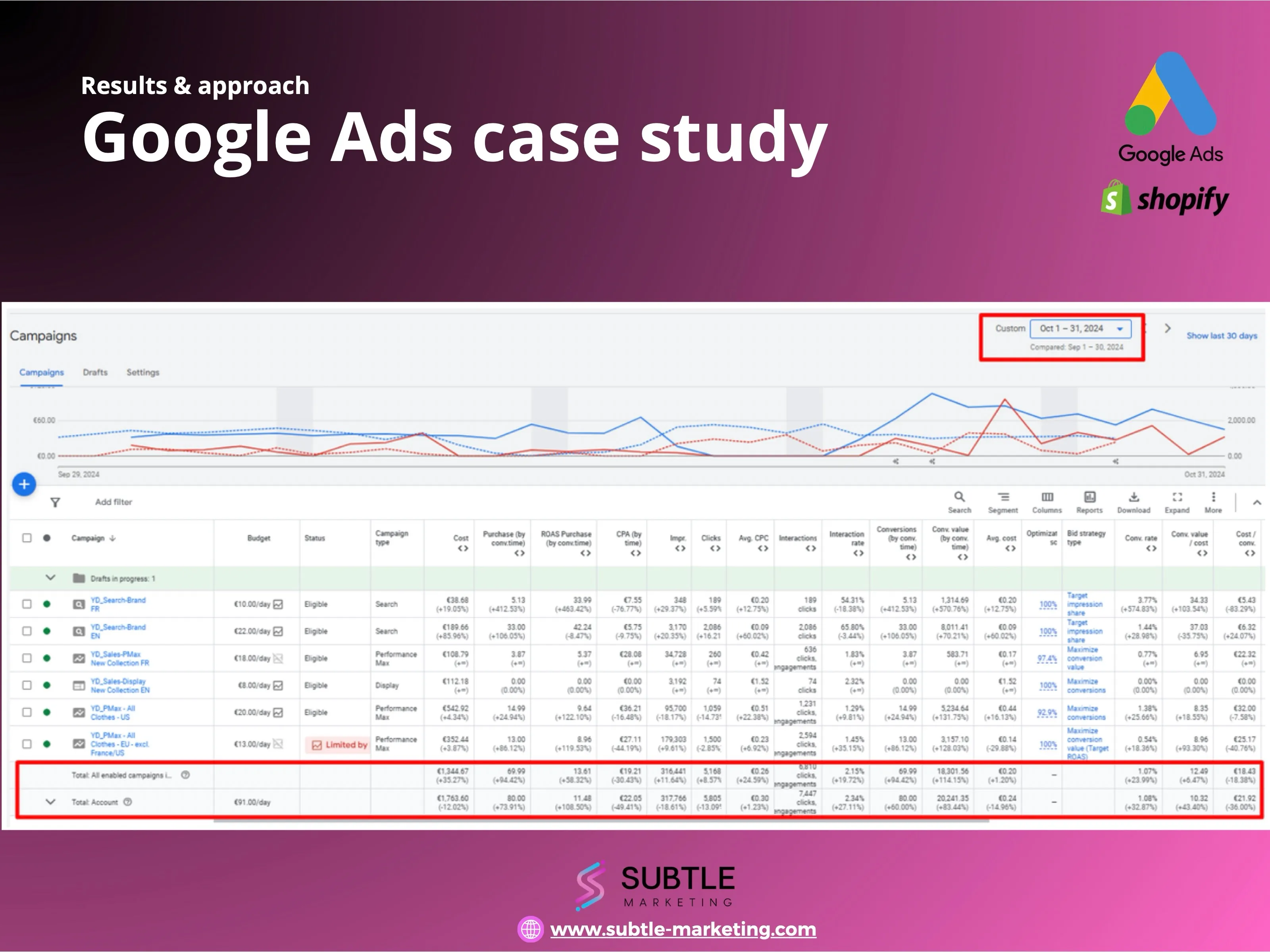
October vs September 2024, CPA down 49%
An authentic French women's clothing brand wanted more sales from Google Ads. We moved the account to Max Conversions and Target Impression Share strategies and, month over month, cut cost per purchase by 49% while revenue rose 26%.
Read case study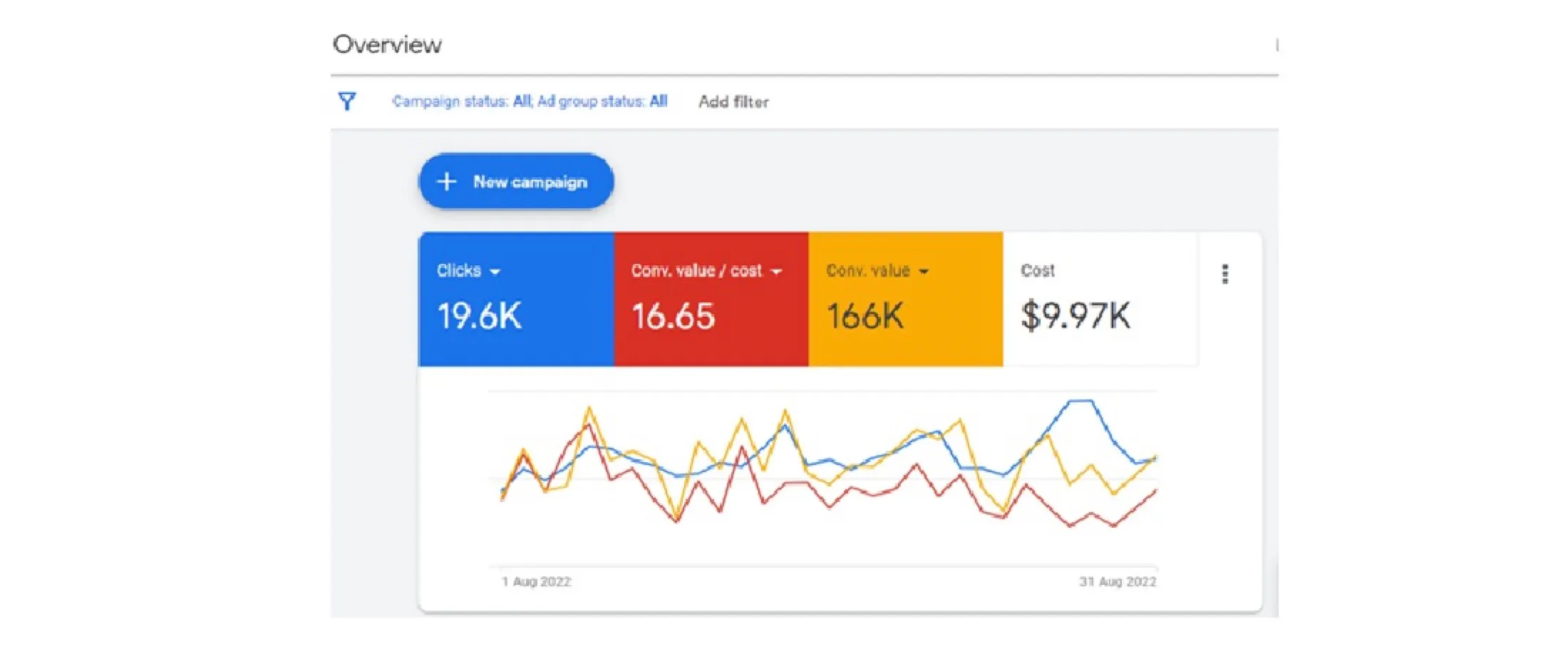
Conversion value per $1 of Google Ads spend
A footwear retailer came to us with Google Ads campaigns that were underperforming because the Shopping feed was never set up properly. We rebuilt the feed, added display remarketing and Performance Max, and tested the checkout. The account now returns $16.65 in sales for every $1 spent.
Read case study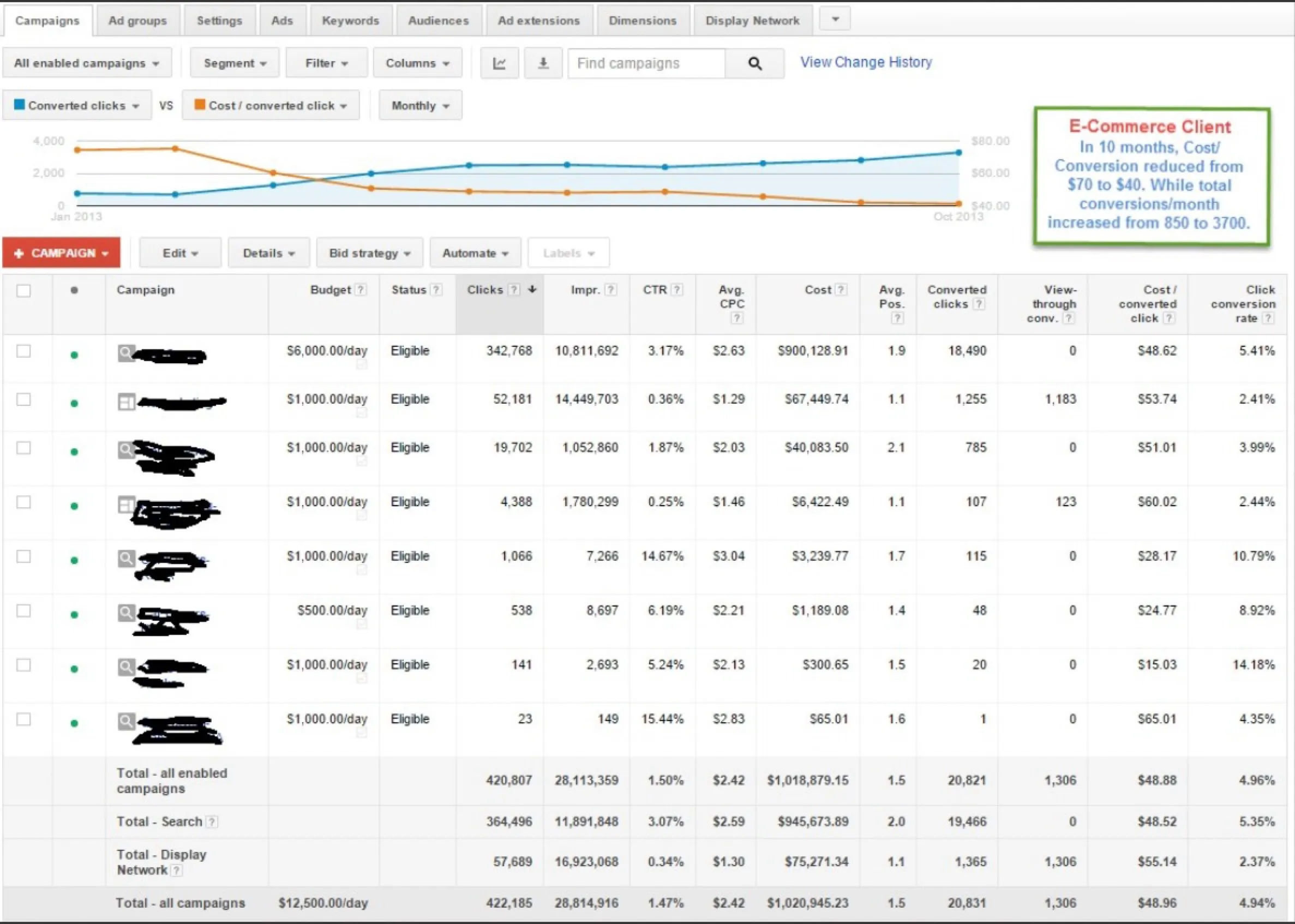
Increase in order throughput
The client wanted lower unit costs and more overall volume. Thousands of negative terms, systematic ad copy tests and several bid strategy tests produced a large drop in unit cost and a four-fold increase in throughput.
Read case study