
How much should you spend on Facebook ads? Do the arithmetic first
Nobody can tell you a budget without your order value, close rate and conversion rate. Here is the calculation, two worked examples, and the floor below which ads cannot work.
Every answer to this question is either “it depends” or a number someone made up. It does depend, but on four things you already know or can look up in ten minutes, and once you have them the budget is arithmetic rather than opinion.
Work backwards from the revenue you need
The calculation runs in one direction only: from the result you want to the money it takes to get it.
- The revenue or number of customers you want per month.
- Average order value, or average deal value.
- Your conversion rate, from click to order, or from lead to customer.
- Your cost per click, from the last 30 days of your own data.
Target revenue divided by order value gives the orders you need. Orders divided by conversion rate gives the clicks you need. Clicks multiplied by cost per click gives the budget. Then divide the revenue target by that budget: the number you get is the ROAS your plan quietly assumes, and that is where most plans fall apart.
Do not use benchmark figures for steps three and four if you have any traffic at all. Your own conversion rate is in GA4 or Shopify reports. Your own cost per click is in Ads Manager. Industry averages are for people with no data, and you probably have some.
Worked example: an e-commerce store
A store wants $50,000 a month in revenue from Meta ads. Average order value is $80 and the site converts paid traffic at 2%.
| Input | Figure | Where it comes from |
|---|---|---|
| Target monthly revenue | $50,000 | Your plan |
| Average order value | $80 | Shopify reports |
| Orders needed | 625 | Revenue divided by AOV |
| Conversion rate, paid traffic | 2% | GA4 |
| Clicks needed | 31,250 | Orders divided by conversion rate |
| Cost per click | $0.90 | Ads Manager, last 30 days |
| Budget required | $28,125 | Clicks multiplied by CPC |
| ROAS this plan requires | 1.8 | Revenue divided by budget |
A 1.8 ROAS on a 40% gross margin loses money on every order. So the plan does not work, and you learned that before spending anything.
Now look at which input moves it. Lifting the conversion rate from 2% to 3% cuts the clicks needed to 20,833 and the budget to $18,750, which is a 2.7 ROAS. Raising average order value to $95 with a bundle has a similar effect. Cutting cost per click by 20% with better creative helps too. Doing all three turns an unprofitable plan into a workable one, and only one of the three is a media buying task. That is why we will often argue for fixing the page before raising the budget when a store asks us to scale.
Worked example: a lead-generation business
A service business wants 10 new clients a month. Average deal value is $3,000. The sales team closes 20% of qualified leads, and about 60% of enquiries are qualified.
| Input | Figure | Where it comes from |
|---|---|---|
| New clients wanted | 10 | Your plan |
| Average deal value | $3,000 | CRM |
| Close rate on qualified leads | 20% | CRM |
| Qualified leads needed | 50 | Clients divided by close rate |
| Share of enquiries that qualify | 60% | CRM |
| Total enquiries needed | 83 | Qualified divided by that share |
| Cost per lead | $35 | Ads Manager |
| Budget required | $2,905 | Enquiries multiplied by CPL |
| Cost per client | $290 | Budget divided by clients |
$290 to win a $3,000 client is a good trade, so this plan is fundable. Notice which numbers you had to take from the CRM rather than the ad account. If you do not know your close rate or what share of enquiries are worth calling, you cannot size a lead-generation budget, and you will end up judging the campaign on cost per lead alone. That is the fastest route to a rising cost per lead and falling sales.
The learning phase puts a floor under the budget
Meta’s own documentation describes an ad set leaving the learning phase at around 50 optimisation events in a rolling week. Below that, delivery stays unstable and the results you see are mostly noise.
Turn that into money. If your cost per lead is $35, 50 leads a week costs $1,750, which is about $7,500 a month per ad set. Most small businesses cannot fund that, and they should not pretend otherwise. The practical responses are:
- Run one ad set, not five. Splitting $3,000 across five ad sets guarantees that none of them learns.
- Optimise for an event that happens more often, such as a lead rather than a qualified consultation, and watch quality separately.
- Use campaign budget optimisation so the budget concentrates where conversions actually happen.
- Accept that you will make decisions on two weeks of data rather than one.
The same logic applies on Google. Thin budgets spread across many campaigns produce accounts full of campaigns that each have too little data to be judged, which is also how Google Ads budgets end up wasted.
Why under $1,000 a month rarely works
$1,000 a month is roughly $33 a day. At a $30 cost per result that is one conversion a day, seven a week, against the 50 the system wants. It can work, slowly, with one ad set and patient creative testing. Below that it generally cannot: at $500 a month you are buying four conversions a week, which is not enough to tell a good ad from a bad one.
That is why $1,000 a month, or PKR 250,000, is the minimum ad budget we recommend. It is not a sales floor. It is the point below which we would be charging you to manage a campaign that cannot gather enough data to improve.
What to spend it on instead until you can fund ads
If your budget is under that floor, there are three things that make every future dollar of ad spend go further, and all of them are one-off costs rather than monthly ones.
- Tracking. Conversion events that fire once, with values, server-side where it matters. Without this you cannot measure anything you spend later.
- One landing page built for one offer. Lifting conversion rate from 1.5% to 3% halves your cost per sale permanently. No bid strategy does that.
- Follow-up speed. If enquiries wait hours for a reply, you are losing leads you already paid for. Automating the first response is cheap, and speed to lead is usually the biggest single improvement available to a small lead-gen business.
Spend two months on those three, then start advertising with a budget that can actually learn. You will get to profitability faster than if you had run thin ads for six months.
What this looks like when we do it
A women’s apparel brand came to us spending $3,000 a day with a cost per conversion 42% above target. We fixed tracking first, rebuilt the funnel, tested new creative weekly and then raised daily budgets in 20% steps with automated rules protecting ROAS. Spend reached $26,849 a day at a 389% blended ROAS over six months, detailed in the women’s apparel ads case study. Scaling was the last step, not the first, and the step size mattered as much as the direction.
Where that leaves you
Run both calculations on your own numbers tonight. If the required ROAS looks achievable and the budget is above $1,000 a month, you have a plan worth funding. If the arithmetic fails, you now know which input to fix first, and it is usually conversion rate or offer rather than budget.
If you want a second opinion on the numbers before you commit, our free audit includes a strategist reviewing your accounts first, or read how we structure paid media once a budget is set.
Common questions
How much should I spend on Facebook ads per day?
Divide your monthly budget by 30, then check it against your cost per result. If one conversion costs $30, a $20 daily budget cannot produce one conversion a day, and the ad set will never gather enough data to optimise. We recommend at least $1,000 a month, which is roughly $33 a day.
Is $500 a month enough for Facebook ads?
Rarely. At a $30 cost per lead that is about 17 leads a month, spread over a week it is four, and no ad set can optimise on four events. We would normally tell you to spend that money on tracking, a landing page or follow-up automation first, then advertise once the budget can support it.
How do I calculate my ad budget from a revenue target?
Divide the revenue you want by your average order value to get the orders needed. Divide that by your landing page conversion rate to get the sessions needed. Multiply the sessions by your cost per click. That is your budget, and dividing the revenue target by it gives the ROAS your plan requires.
How fast can I increase my ad budget?
Raise it in steps of around 20% and wait for delivery to settle before the next one. Sharp increases push ad sets back into the learning phase and costs usually spike for several days. Scaling an account from $3,000 to $26,849 a day, as we have done, is a series of small steps, not jumps.
Proof from our work
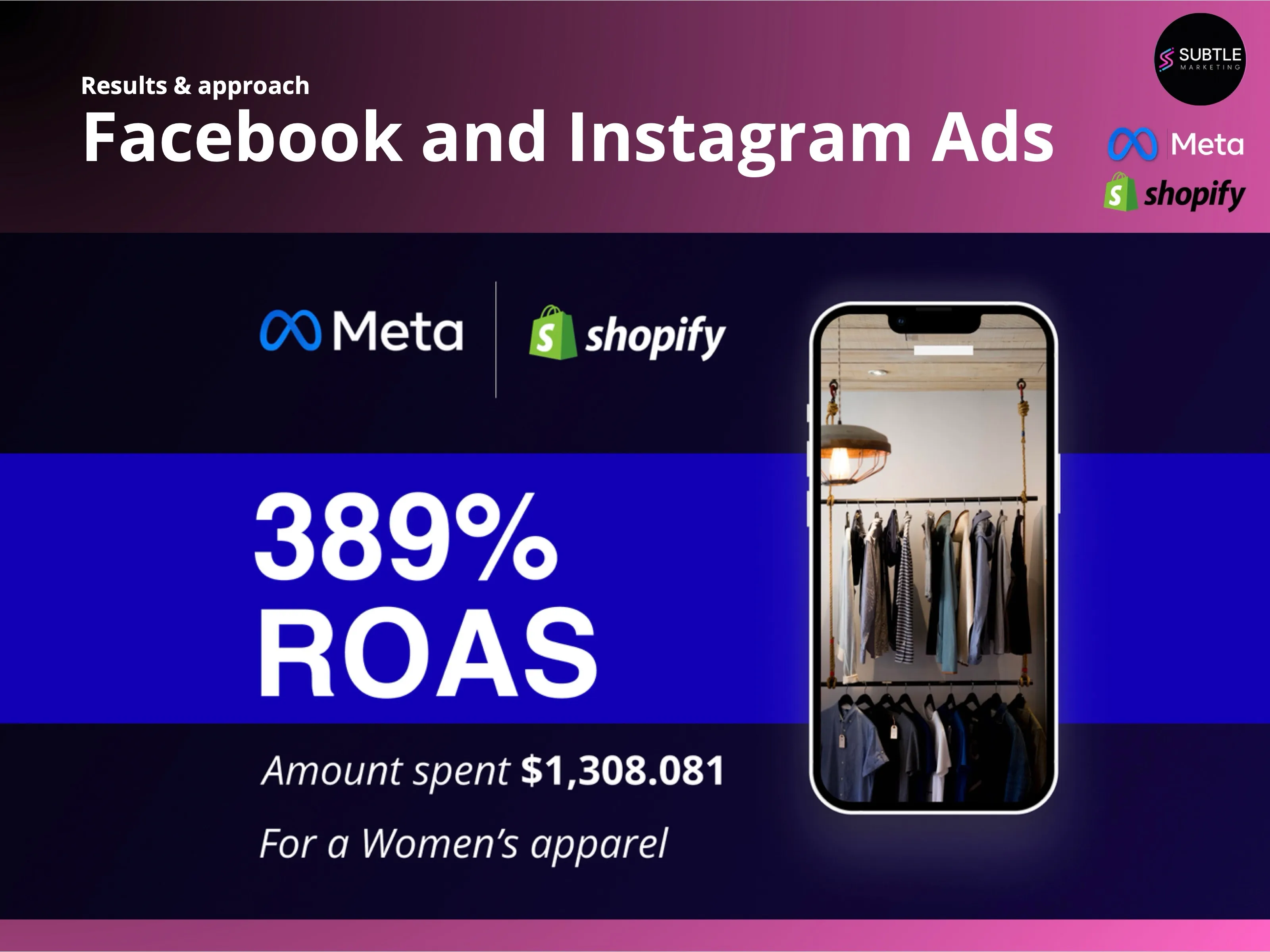
Blended return on ad spend
A Shopify women's apparel brand came to us with a 42% higher cost per conversion than target and campaigns that would not scale. Six months later the account was spending $26,849 a day at a 389% blended ROAS.
Read case study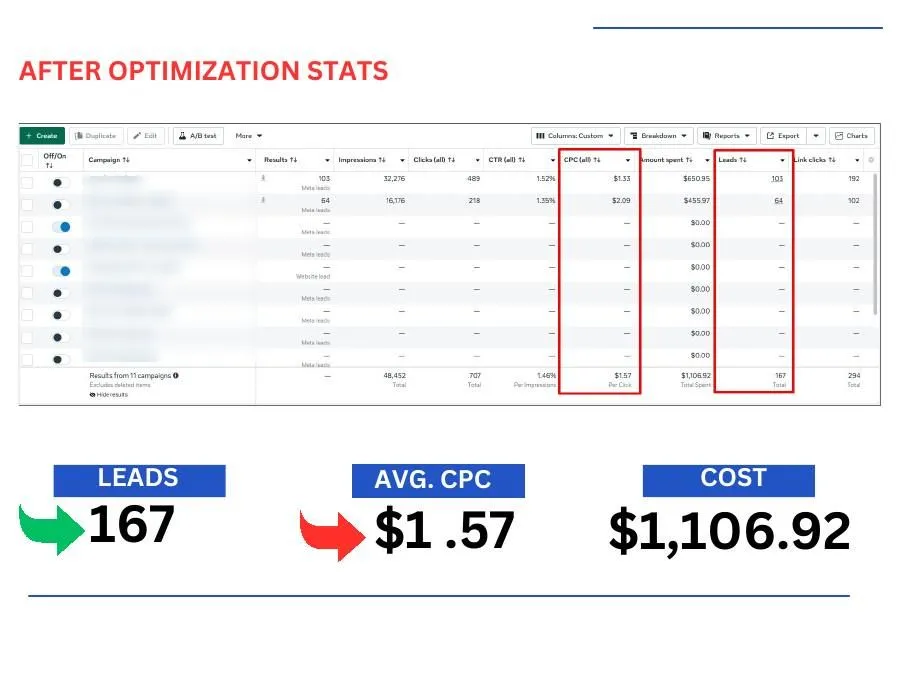
In one month at $1.57 CPC
A commercial real estate training programme needed a steady flow of motivated agents. Our Meta ads campaign delivered 167 leads at an average CPC of $1.57 on a total spend of $1,106.92.
Read case study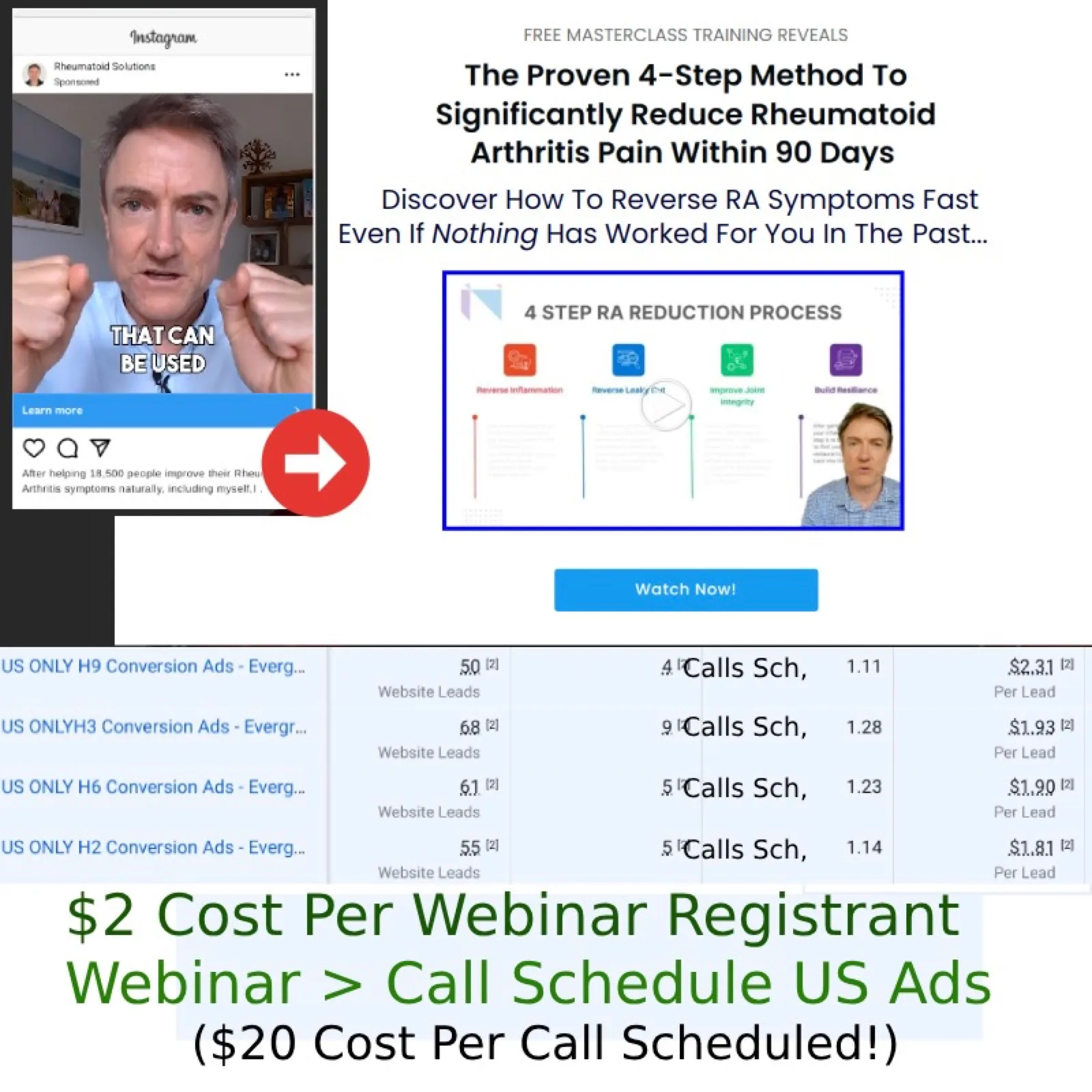
Cost per webinar registration in the US
The client needed to launch webinar ads to a US audience. We scripted the video ads, wrote the copy and ran the campaign, ending at around $2 per registration and $20 per scheduled call.
Read case study