
Why your cost per lead is rising, and the order to fix it in
Your cost per lead was $22 and now it is $41, with nothing obviously changed. There are four causes, and chasing the cheapest one first usually costs you sales.
Your cost per lead was $22 for months. It is $41 now, nothing obvious changed, and every suggestion you have been given involves new audiences. Before you rebuild anything, it is worth knowing which of four things is actually happening, because the fixes point in different directions and two of them make the problem worse.
First, check that it is really rising
Weekly lead numbers are noisy, especially under 50 leads a week. Pull a 14-day window against the previous 14 days rather than week against week, and look at three numbers together: CPM, CTR and cost per lead.
That combination tells you where the increase came from.
- CPM up, CTR flat: the auction got more expensive. Competition or seasonality.
- CPM flat, CTR down: your ads stopped working on this audience. Creative fatigue.
- CPM up and CTR down together: saturation. The same people are seeing the same ads too often.
- Everything flat but CPL up: you have a counting problem, not a media problem. Something stopped recording leads.
Rule that last one out before anything else. A form change, a consent banner, a new thank-you page or a broken CRM webhook will all cut recorded leads without touching real ones, and you will spend a fortnight optimising a reporting fault. Check the volume of leads in your CRM against the platform for the same dates. If they disagree by more than a rounding error, start with tracking and analytics.
Creative fatigue: the number that tells you when to refresh
Frequency is the metric that shows you fatigue before cost per lead does. Add Frequency and Impressions to your columns and set the date range to the last 7 days, not lifetime, because lifetime frequency on a long-running ad set tells you nothing about this week.
Our working rule on cold audiences: when 7-day frequency passes about 2.5 and click-through rate has fallen while CPM holds roughly steady, the creative is done. Not the ad set, not the targeting, the creative. Start producing replacements when frequency hits 2, so you are not scrambling when performance drops.
What a refresh means matters as much as the timing. A new colour on the same image is not a new ad. A different angle is: a different problem in the hook, a different proof element, a customer’s words instead of yours, a video where there was a static. Three genuinely different angles beat ten variations of one.
Audience saturation in a small market
If you sell to a city rather than a country, this is probably your main constraint. A targetable audience of 300,000 people, at 60,000 impressions a week, reaches a meaningful share of itself within a month. No amount of audience research creates more people.
What works in small markets:
- Treat creative volume as the growth lever, because reach is capped.
- Widen the geography before you widen the interests. A second town is new people; a second interest in the same town is mostly the same people.
- Run a deliberate exclusion window so you are not paying to re-reach everyone who enquired in the last 30 days.
- Accept a higher ceiling on CPL as you scale, and decide in advance what number stops being profitable.
That last point is the one people skip. Cost per lead in a small market rises as you spend more, and the question is not how to prevent that but how high you can let it go. Work that out from your deal value and close rate, the same arithmetic as setting an ad budget in the first place.
Auction competition and seasonality
You share the auction with everyone who wants your audience’s attention, not just your competitors. A retail peak, an election, a holiday or a large brand’s campaign all raise what you pay, and nothing in your account caused it.
You can see this. Set the date range to the same month last year and compare CPM. If last year’s line has the same shape as this year’s, you are looking at seasonality, and the right response is budget planning rather than account surgery. Where you do have leverage is relevance: a higher CTR lowers what you pay for the same delivery, which is why creative work beats bid tinkering when the auction tightens.
The trap: optimising for leads nobody can sell
This is the part that costs real money. Loosening the form, dropping the qualifying question, switching to the highest-volume form type and optimising for the cheapest event will all drive CPL down. They also change who replies.
Here is the arithmetic, using round numbers to make the shape clear. Say you spend $4,000 a month.
| Cheap leads | Qualified leads | |
|---|---|---|
| Cost per lead | $20 | $45 |
| Leads | 200 | 89 |
| Share worth calling | 15% | 60% |
| Qualified leads | 30 | 53 |
| Close rate on qualified | 20% | 20% |
| Sales | 6 | 11 |
| Cost per sale | $667 | $364 |
Same spend, half the leads, nearly twice the sales. The cheap column also quietly consumes far more of your team’s time, because someone still has to call 200 people.
Three ways to optimise for the right lead instead:
- Put the filter in the creative. Stating a price, a minimum budget or a service area costs you volume and buys you intent.
- Ask one qualifying question in the form, and make it a choice rather than free text so people answer it.
- Send qualification status back to the platform. Meta’s conversion leads optimisation and Google’s offline conversion imports both exist for this, and both need your CRM to report which leads were real. That is a CRM job before it is an ads job, and on most lead accounts it is the highest-leverage change available.
Then there is the fourth lever, which has nothing to do with cost: answer faster. The same lead is worth more at two minutes than at two hours, which is why speed to lead often beats any CPL improvement you could buy.
Fix it in this order
- Measurement. Confirm platform leads match CRM leads for the same dates.
- Offer and form. Is the thing you are asking for still worth the information you want for it?
- Creative. Three new angles, not variations, judged on 7-day frequency and CTR.
- Audience. Widen geography, refresh exclusions, consolidate ad sets that are too small to learn.
- Budget and bids. Last, because a bid change on a fatigued creative only changes how fast you lose.
Most accounts we audit want to start at step five. Starting at step one usually makes steps four and five unnecessary. If the form itself is the bottleneck, it is also worth comparing lead ads with landing pages before you rebuild either.
What this looks like when we do it
For a real estate client we ran a Meta programme that produced 167 leads in a month at a $1.57 cost per click, with the qualifying questions sitting inside the campaign rather than being left to the sales team. The real estate Meta ads case study shows the structure. The thing worth copying is not the number, it is that lead quality was designed into the creative and the form before anyone looked at cost per lead.
The decision in front of you
If your CPL has risen and your cost per sale has not, you may have nothing to fix. If both have risen, work the five steps above in order and resist the temptation to start with bids. If you do not know your cost per sale, that is the first thing to build, because without it every CPL decision is a guess.
We can do that work with you in your own accounts: see paid media, or book a free audit and get a strategist’s read on the account before the call.
Common questions
Why is my cost per lead increasing?
In most accounts it is creative fatigue first: the same audience has seen the same ads too often, click-through rate falls and the platform charges more for the same delivery. The other three causes are audience saturation in a small market, more competition in the auction, and a tracking change that quietly stopped some leads being counted.
How often should I refresh ad creative?
Judge it by frequency and click-through rate rather than the calendar. On a cold audience we start building replacements when 7-day frequency passes roughly 2.5, and swap them in when CTR has clearly dropped while CPM is flat. In small local markets that can mean new creative every two to three weeks.
Is a higher cost per lead always bad?
No. If cost per lead rose 30% but the leads now book calls and buy, your cost per sale may have fallen. CPL is only a useful number next to lead quality. The worst accounts we see have a very low CPL and a sales team that closes almost none of it.
How do I get cheaper leads without getting worse leads?
Qualify earlier rather than loosening the form. Ask one filtering question in the ad or form, state the price or minimum budget in the creative, and feed qualification status from your CRM back to the ad platform so it learns which lead type to find more of.
Proof from our work
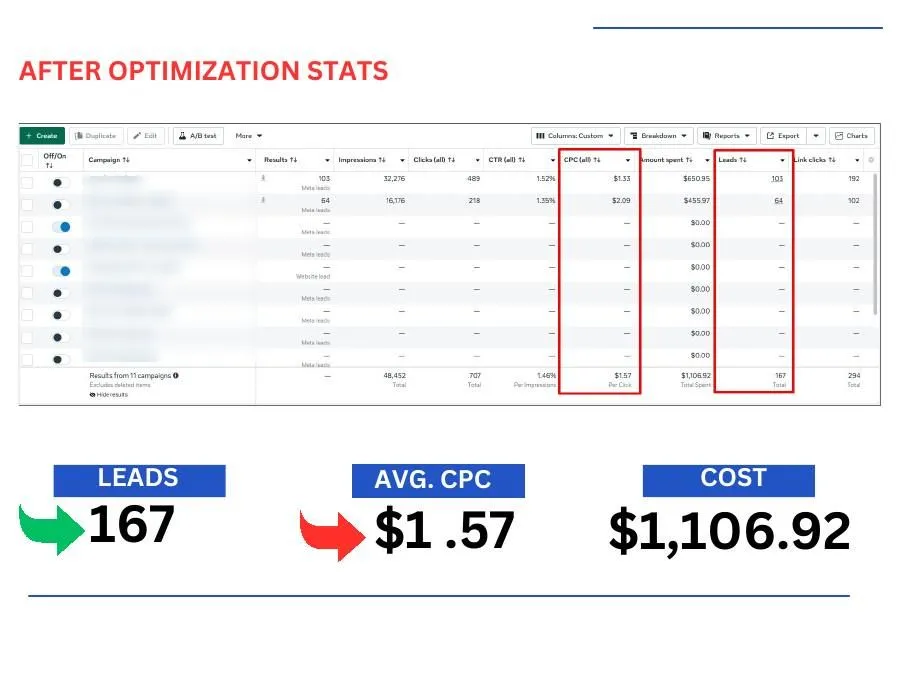
In one month at $1.57 CPC
A commercial real estate training programme needed a steady flow of motivated agents. Our Meta ads campaign delivered 167 leads at an average CPC of $1.57 on a total spend of $1,106.92.
Read case study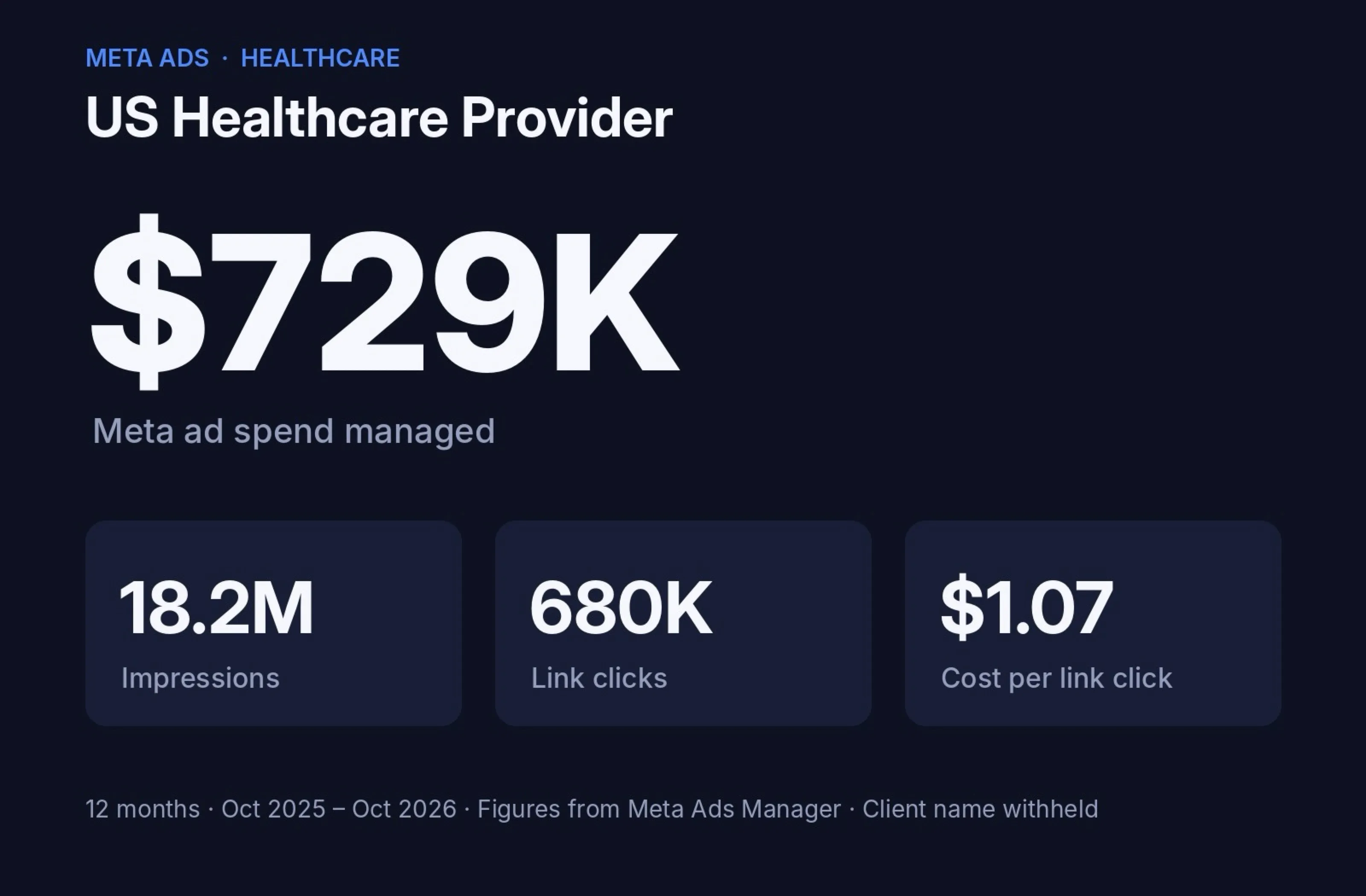
Meta ad spend managed in 12 months at $1.07 per link click
A US healthcare provider needed steady patient demand at scale without traffic costs creeping up. Across two ad accounts and twelve months we managed $728,794 of Meta spend, delivering 680K link clicks at $1.07 each and a 3.7% click-through rate.
Read case study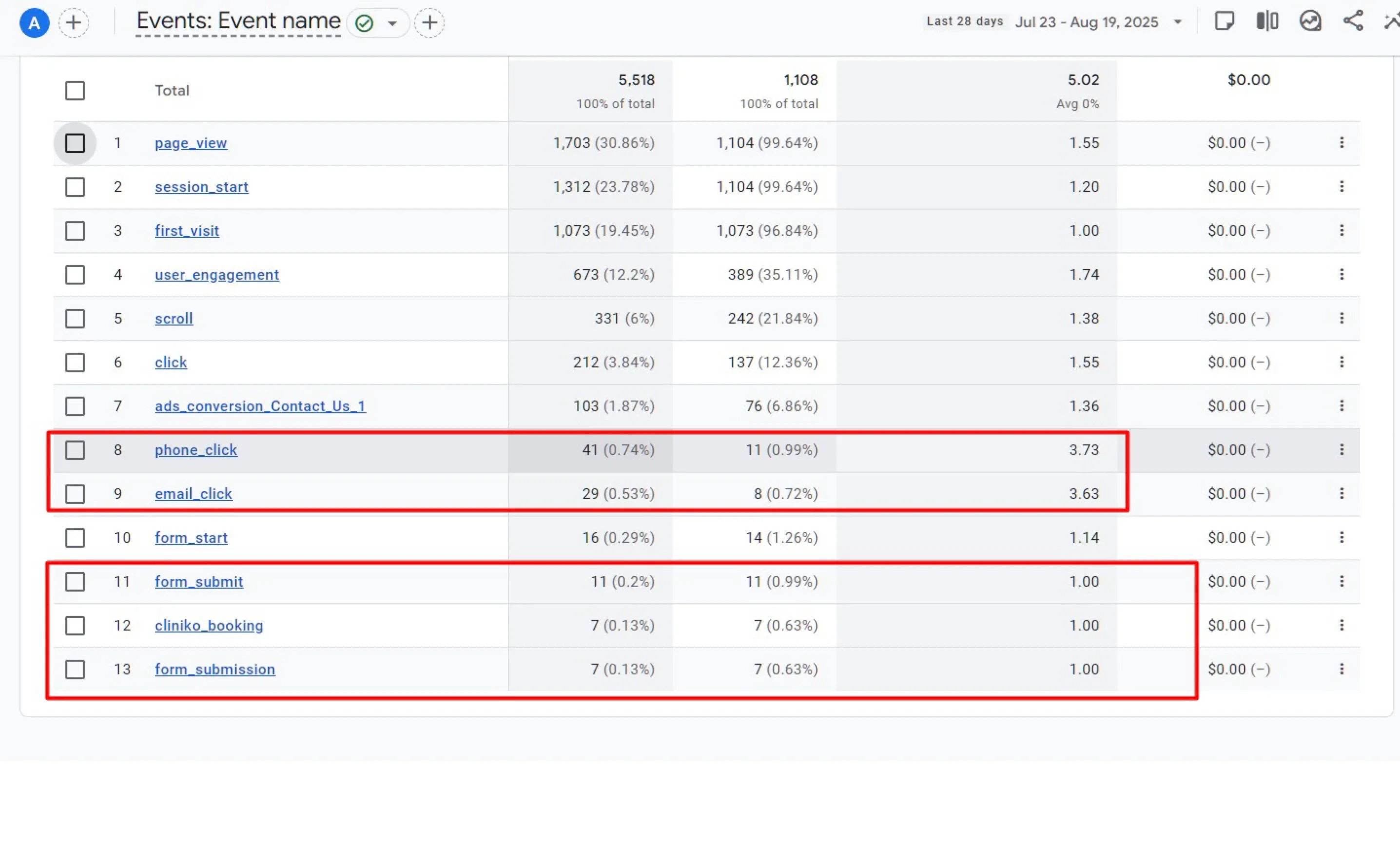
Form, booking and phone-call tracking in Google Tag Manager
- Set up form_start and form_submit events, phone and email click events, and…
- Handled the platform quirks for WordPress, Squarespace and Wix sites, and for Calendly…
- Sent the same events to GA4 and the Meta Pixel so ad platforms could optimise for real…