
Meta lead ads vs landing pages: which one you should actually run
Lead ads nearly always produce cheaper leads. That is not the same as more customers. Here is how the two formats differ and when each is the right choice.
Someone has told you lead ads halve your cost per lead. Someone else has told you lead ad leads are rubbish. Both are usually right, which is why the comparison only becomes useful once you decide which number you are managing: cost per enquiry, or cost per customer.
What each format actually changes
A Meta lead ad opens an instant form inside Facebook or Instagram, pre-filled with the name, email and phone number on the person’s profile. Nothing loads. Nobody leaves the app. Two taps and the form is submitted.
A landing page sends the click to your site, where the page has to load, convince, and then persuade someone to type their details in. Every one of those steps loses people, and every one of them is also an opportunity: to show the price, prove you are real, answer an objection, and ask a question that filters out the people you do not want.
So the trade is not about forms. It is about whether removing friction helps you or hides a problem.
There is a second difference that matters later. A lead ad produces a contact record and nothing else. A landing page produces a contact record plus everything around it: which page they saw, how long they stayed, which section they read, whether they came back. When you want to know why one campaign sells and another does not, that context is what you use, and the lead ad does not have it to give you.
Where lead ads win
Cost per lead. Removing the page load and the typing lifts completion rates substantially. In most accounts this is the single biggest difference between the two formats.
Mobile reality. The majority of this traffic is on a phone, often on a poor connection. A page that takes four seconds to load loses people who would have tapped twice inside the app.
Speed to launch. You can run a lead ad campaign this afternoon without a developer, a page, or a hosting decision.
Small budgets. If your budget cannot support both ad spend and a page build, the lead ad gets you data sooner. This matters more than it sounds when you are working near the minimum budget where ads can learn at all.
Where landing pages win
Lead quality. People who read a page before enquiring know what they are asking for. That shows up in answer rates, show rates and close rates rather than in Ads Manager.
Qualification. A page can ask five questions, show a price range, require a budget selection, or put a calendar in front of someone instead of a form. Instant forms are far more limited.
Tracking and remarketing. A landing page gives you a site visit: GA4 data, a remarketing audience, scroll and session data, and a conversion event you control. Lead ads happen inside Meta, so your analytics see almost nothing. If attribution matters to you, this is the deciding factor.
Explaining things. Anything with a price above a few hundred dollars, anything regulated, anything a buyer needs to compare: these all need more words than an instant form allows.
Reusability. The page works for Google, email, organic and referral traffic. The instant form works in one place.
The comparison, side by side
| Meta lead ads | Landing page | |
|---|---|---|
| Cost per lead | Usually clearly lower | Higher |
| Share of leads worth calling | Lower unless you qualify deliberately | Higher |
| Mobile friction | Minimal | Depends entirely on load speed |
| Qualification available | One or two questions, limited field types | Unlimited, including price filters and booking |
| Tracking | Lives in Meta; little GA4 visibility | Full site analytics and conversion control |
| Remarketing audiences | Form openers and engagers only | Every visitor, plus behavioural segments |
| Set-up time | Hours | Days, if the copy is already written |
| Works for other channels | No | Yes |
| Risk if follow-up is slow | High: the person never left the app | Lower: they chose to visit you |
| Best for | High-volume local services, event signups, cold audiences | Considered purchases, high ticket, anything needing proof |
How to qualify inside a lead ad form
Most of the quality complaint about lead ads is a setup problem, not a format problem. Five changes, all in the instant form editor:
- Change the form type. Switch from the higher-volume option to the higher-intent one. It adds a review step before submission, which costs you some volume and removes a lot of accidental submissions.
- Add one multiple-choice question, first. Budget band, timeline, postcode, property type, or “which of these describes you”. Multiple choice gets answered; free text does not.
- Do not rely on pre-filled fields alone. A form that only collects profile data can be completed without reading anything. One typed or chosen answer changes that.
- Put the filter in the creative too. “From $4,000” or “for homeowners in Manchester” costs you cheap clicks and buys you intent. This is the same principle that keeps cost per lead honest instead of just low.
- Set a real custom completion screen. Send people to a page with next steps, a calendar link or a WhatsApp button. Some will book immediately, and those are your best leads.
Then connect it properly. An instant-form lead should land in your CRM in seconds and trigger an SMS or WhatsApp message straight away, because the person never left Facebook and has no memory of your brand. A lead ad without that connection is worse than no lead ad, and it is the most common failure we see. Getting it right is a CRM and funnel job: pipeline, automation, and a follow-up sequence that starts immediately. The evidence on how fast you need to reply is the reason we build this before launching the ads, not after.
The hybrid approach, and how to split it
Running both is usually the right answer. Split by audience temperature rather than by budget:
- Cold audiences: lead ads. People who have never heard of you will not read 800 words, and friction costs you more than quality does at this stage.
- Warm traffic, retargeting, and anyone who has visited the site: landing page. They are willing to read, and you want the tracking.
- High-value offers: landing page first, lead ad as a test rather than the default.
Measure both on the same three numbers: cost per lead, cost per qualified lead, and cost per sale. Give it 30 days and enough volume that each format produces at least 30 leads, then put the budget where cost per sale is lowest. One rule keeps the test honest: do not change the offer halfway through. If the lead ad promises a free quote and the page promises a free quote plus a guide, you are comparing offers rather than formats, and you will draw the wrong conclusion about both. If you want Meta to help, feed qualification status back from the CRM so its conversion leads optimisation learns which lead type to find.
What this looks like when we do it
For a real estate client we ran a Meta programme that produced 167 leads in a month at a $1.57 cost per click, with qualifying questions built into the campaign rather than left for the sales team to discover on the phone. The real estate Meta ads case study has the structure. The pattern we repeat on lead-gen accounts is the same every time: decide where qualification happens before you choose the format.
Where that leaves you
If your sales team is complaining about quality, the answer is not necessarily a landing page. Fix the form type, add a qualifying question, state the price in the creative and connect the CRM, then re-measure. If you are selling something that genuinely needs explaining, build the page and accept the higher cost per lead.
We build both, in your own accounts: see landing pages and CRO. If you would rather have someone look at what you already run, the free audit comes with a one-page action plan you keep.
Common questions
Are Meta lead ads better than landing pages?
They are cheaper per lead and worse per lead. Lead ads remove the click to a website, so forms get completed more often, but you lose the chance to explain, qualify and build trust. Landing pages cost more per enquiry and usually produce a higher share of people who can actually buy.
Why are my Meta lead ads producing poor quality leads?
Usually because the form is set to the high-volume type, every field is pre-filled from the person's profile, and nothing in the ad or form filters anyone out. Switch to the higher-intent form, add one multiple-choice qualifying question, and state the price or minimum budget in the creative.
Can I use lead ads and a landing page in the same campaign?
Yes, and it is often the right answer. Run lead ads to cold audiences where friction kills volume, and send warm and retargeting traffic to a landing page where people are ready to read. Compare the two on cost per qualified lead and cost per sale, not cost per lead.
Do lead ads work for high-value services?
They can generate enquiries, but for high-priced or complex services the enquiry often arrives without the person understanding what they asked for. For those offers we normally use a landing page, or a lead ad with two qualifying questions followed by immediate automated follow-up.
Proof from our work
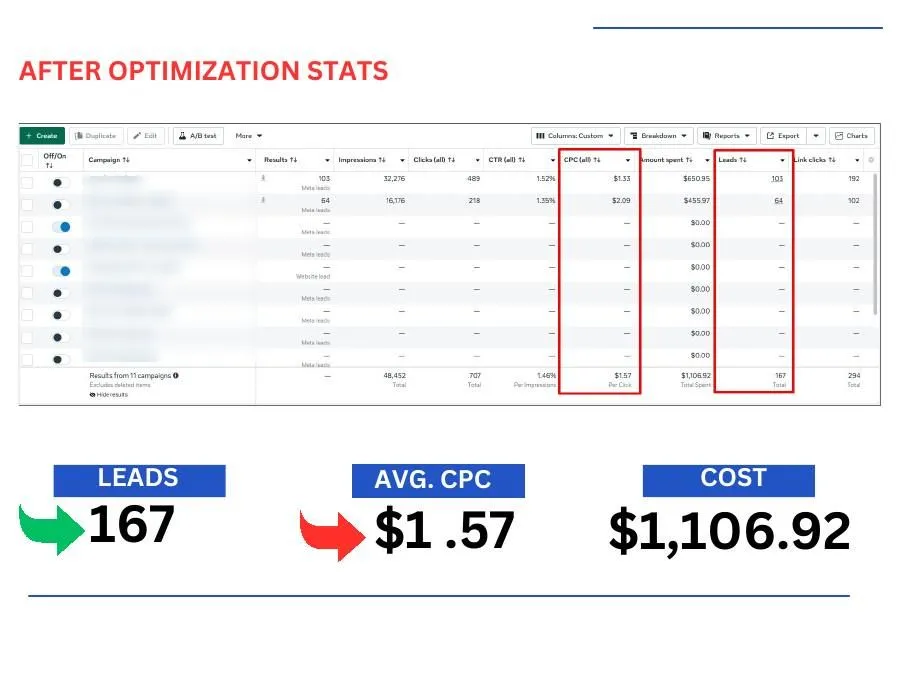
In one month at $1.57 CPC
A commercial real estate training programme needed a steady flow of motivated agents. Our Meta ads campaign delivered 167 leads at an average CPC of $1.57 on a total spend of $1,106.92.
Read case study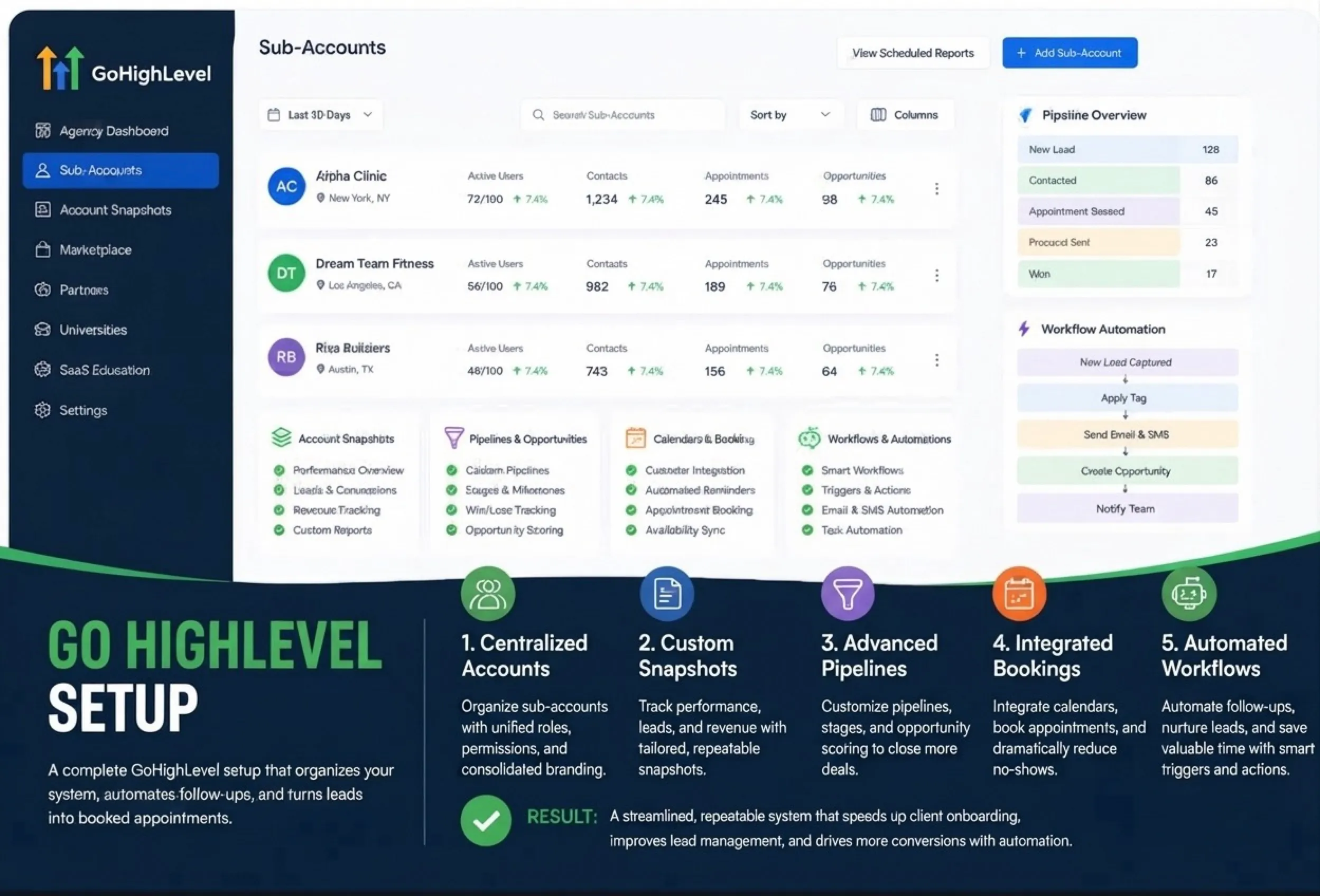
GoHighLevel CRM setup for leads, bookings and team follow-up
- Account structure, sales stages, calendars and contact data organisation
- Automated email and SMS journeys for new leads and booked appointments
- User access, tags, custom fields, task alerts and conversion tracking
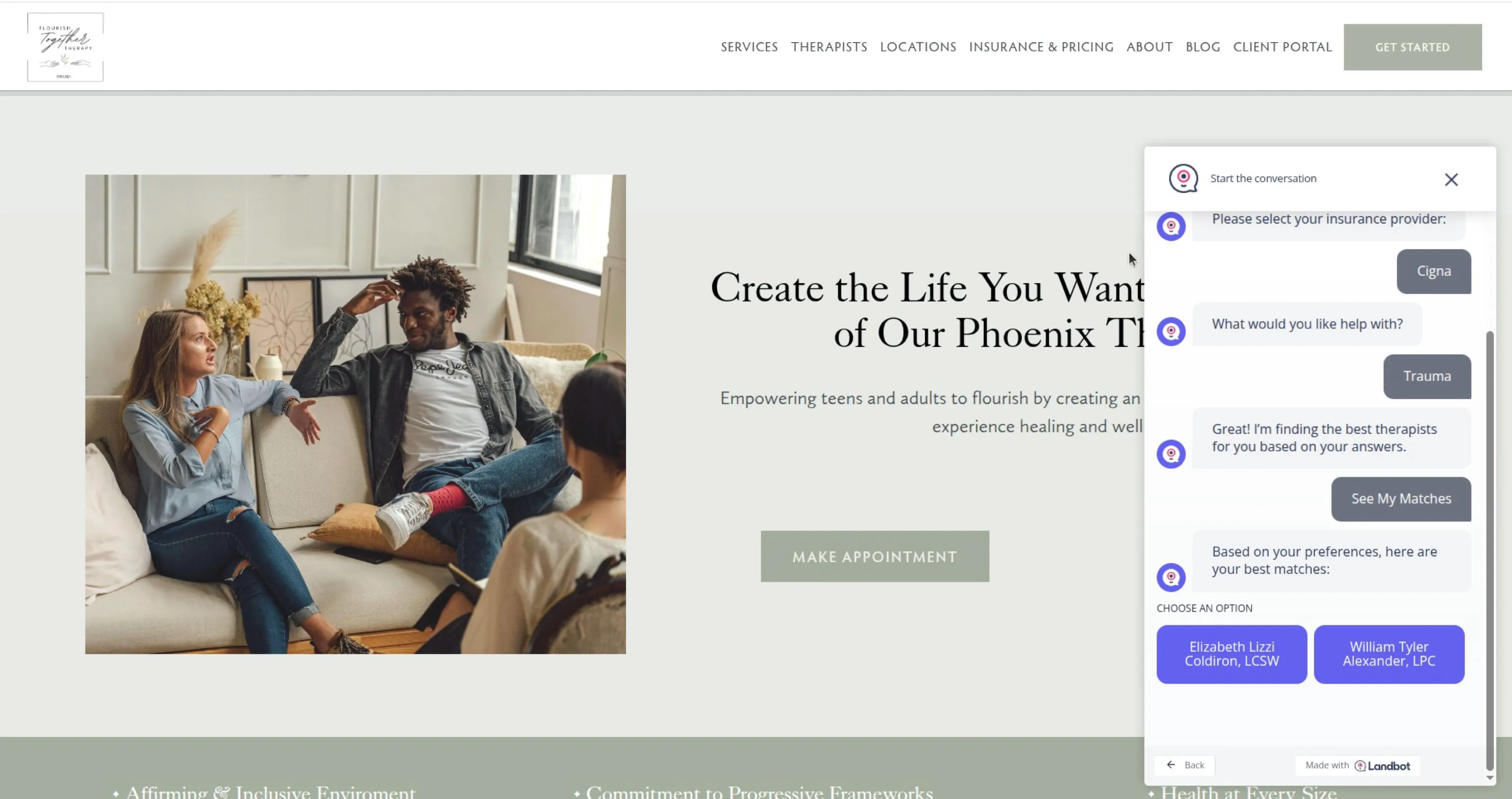
Intake form completion vs the old form
A conversational chatbot for a therapy practice that qualifies prospective clients, matches them to the right therapist, shows insurance options and captures location in a friendly chat flow. Intake completion tripled.
Read case study