
How to get more patients for your clinic
The diary has gaps next month and the marketing is not filling them. Often the problem is not the number of enquiries but what happens in the hour after one arrives.
Next month’s diary has gaps in it, and the marketing you are paying for has not filled them. Or the enquiries do arrive, the front desk is busy, and the diary still looks the same, which is a completely different problem with a completely different fix.
There are six stages between someone searching for a treatment and sitting in your chair. Adding spend only helps if the leak is at the top. Here is the whole path, in the order we would work through it.
Which demand are you buying?
Clinic marketing splits cleanly in two, and confusing them is the most common reason a budget underperforms.
Demand you capture. Someone in your city types “emergency dentist near me” or “invisalign cost” tonight. They are going to book somewhere this week. You win these with your Google Business Profile, your map pack position, your reviews and a page that matches the treatment they searched for. Cost per patient here is the lowest you will ever see, and the supply is capped by your local search volume.
Demand you create. Nobody wakes up wanting a skin consultation. Paid social interrupts them with a specific treatment and a specific reason to act now. The supply is effectively unlimited and the cost per enquiry is higher, because you are paying to generate the intent as well as capture it.
You need both, but you should exhaust the first before scaling the second. Capturing demand you already have is cheaper than manufacturing new demand, every time.
Google Business Profile: the cheapest patients you will ever get
Before a single pound goes into ads, go through the profile. Most clinic profiles we audit are missing three or four of these.
- Primary category set to the specific practice type, not “Doctor”. Add secondary categories for other treatments you want to appear for.
- Services listed individually with descriptions, so each treatment you offer is a separate entry rather than buried in your profile text.
- Appointment link pointing at your booking system, not your homepage.
- Hours, including a holiday schedule, because a wrong “closed” label loses the patient to the next result.
- Photos added regularly: the building from the street, reception, treatment rooms, the team. Street-level shots matter because patients use them to find your door.
- Q&A seeded with the questions your front desk answers all day: parking, prices, whether you take a particular insurer.
- Reviews, answered. Every one, including the bad ones, in a measured voice.
Pair the profile with one page per treatment and per location on your site. Our local SEO checklist covers the full on-site side. Be realistic about the timeline: local SEO takes three to six months to move rankings, so start it now and fund this quarter with ads.
Paid ads for clinics: what policy actually allows
This is where generic agencies get clinics into trouble. Both major platforms treat health as a sensitive category, and the restrictions are not an edge case.
Meta’s advertising policies prohibit ads that imply knowledge of a person’s health condition, which rules out the direct-address copy that works in other industries. Meta has also removed detailed targeting options based on health interests, so you cannot build an audience of people interested in a condition. Google requires certification for several healthcare categories and limits personalised advertising for health, which means remarketing lists behave differently from the ones you would build for a shop.
Practically, that leaves you with:
- Treatment-led creatives. Say what the treatment is, who it suits, what it costs and how long it takes. Do not describe the reader’s condition back to them.
- Geography and broad demographics for targeting, with the creative doing the qualifying. One offer per campaign, so you can read the results.
- Search intent on Google, where the patient has already declared what they want, plus brand search so you are not paying a competitor to intercept your own name.
- A landing page per treatment, with price ranges, practitioner credentials and the answers to the three questions every patient has: what does it cost, will it hurt, how long does it take.
A US healthcare provider we run Meta for has had $729K of spend managed across twelve months at $1.07 per link click with a 3.7% click-through rate, inside those same policy limits. The constraint is real and it is workable.
The gap between enquiry and booked appointment
This is the part nobody audits, and it is usually the biggest number on the table. Run this check today: find the last twenty enquiries, and for each one write down the time it arrived and the time someone replied.
| Symptom | Likely cause | Fix |
|---|---|---|
| Plenty of enquiries, flat bookings | Median response time measured in hours, not minutes | Automated first reply within 60 seconds, with a booking link |
| Enquiries dry up after 6pm | Nobody covers evenings and weekends, when patients actually research | A chatbot or WhatsApp assistant that answers and books out of hours |
| Form submissions started but not finished | A 20-field intake form on a mobile screen | Conversational intake, one question at a time |
| Patients book then disappear | No confirmation, no reminder, no easy reschedule | Confirmation on booking, reminders at 24h and 2h, one-tap reschedule |
| Leads ring once and are never contacted again | No pipeline, follow-up lives in someone’s memory | Stages in a CRM with tasks, and a sequence over 14 days |
| Good month, empty month | All acquisition, no reactivation of past patients | A reactivation sequence to the existing patient list |
The first row is the one that pays for itself fastest. A patient who enquires with three clinics books with whichever replies first, which is the whole argument in why speed to lead decides who wins the enquiry.
Intake that qualifies without feeling like an interrogation
Long forms are not thorough, they are just long. Most visitors abandon them, and the ones who finish still need manual triage by someone who could be doing something else.
Conversational intake asks one question at a time: what are you looking for, how soon, which location suits you, do you have insurance and with whom. It feels like a conversation rather than paperwork, and because each answer arrives separately you can branch. Someone asking about a treatment you do not offer gets told so politely instead of taking up a consultation slot.
Done properly it also routes. We built one for a therapy practice that matches the enquirer to the right therapist, shows insurance options and captures location inside the chat before booking: intake completion tripled. The clinical judgement stays with your clinicians. What the assistant does is collect the facts, book the slot and hand over a tidy summary.
Reminders, and the admin they drag with them
Every no-show is an ad cost with no appointment attached. The fix is unglamorous: confirmation at the moment of booking, a reminder 24 hours before, another 2 hours before, and a one-tap reschedule link in both, set up in your practice software where it has an API or in a CRM where it does not. Making it easy to move an appointment sounds like it would cost you bookings. It recovers slots that would otherwise be silently lost. We go through the mechanics in cutting no-shows with WhatsApp automation.
The same wiring removes admin. For one medical clinic we connected intake, PDF invoicing, payment detection and calendar booking in a single n8n workflow and admin time per patient fell by 90%, with staff touching one tool instead of four.
Reviews: the only asset that compounds
Reviews do two jobs at once. They lift your map pack position, and they close the patient who is comparing you with two other clinics in the same tab. A steady flow matters more than a one-off push, so ask at the moment of maximum goodwill, which is usually right after the appointment, by SMS, with the link one tap away. Automate the request and the follow-up; never incentivise or script the content.
What this looks like when we do it
We start with tracking for enquiry, booking and show-up, then one treatment campaign with its own landing page, then the intake and reminder automation behind it. Campaigns are live within 14 days and run in your own ad accounts. The patterns come from work like the $729K Meta programme for a US healthcare provider and the clinic automations above, adapted to one practice rather than copied wholesale.
So the decision is not whether to spend more. It is which of the six stages is leaking, and you can find that out this afternoon with the twenty-enquiry check above. If you would rather have someone else do it, book the free audit: a strategist reviews your accounts beforehand and you keep the one-page plan either way.
Common questions
How do I get more patients for my clinic?
Work both sides. Capture the people already searching with a complete Google Business Profile, local landing pages and reviews. Create demand with treatment-specific paid ads. Then fix the gap between enquiry and booked appointment, which is where most clinics lose more patients than they gain from any ad change.
How much should a clinic spend on ads to get patients?
We recommend a minimum of $1,000 a month in ad spend, because below that a campaign cannot gather enough conversion data to optimise. If your budget is smaller, spend it on tracking, your Google Business Profile and intake automation first. Those keep working when you pause the ads.
Can clinics advertise medical treatments on Meta and Google?
Yes, within policy. Meta prohibits ads that imply knowledge of a person's health condition and has removed detailed health interest targeting. Google requires certification for some healthcare categories and limits personalised advertising for health. Compliant creatives lead with the treatment and the offer, not the patient's condition.
What is a good no-show rate for a clinic?
Lower than whatever yours is now, and the fix is mechanical rather than clever. Confirmation at the moment of booking, a reminder 24 hours before, a second 2 hours before, and a one-tap reschedule link in both. Giving patients an easy way to move an appointment recovers slots that would otherwise be lost.
How quickly will clinic marketing start producing enquiries?
Paid campaigns usually produce enquiries in the first week once tracking and pages are live, which we do within 14 days. Local SEO and reviews take 3 to 6 months to move rankings. Run the paid side while the organic side matures, and judge each on its own timeline.
Proof from our work
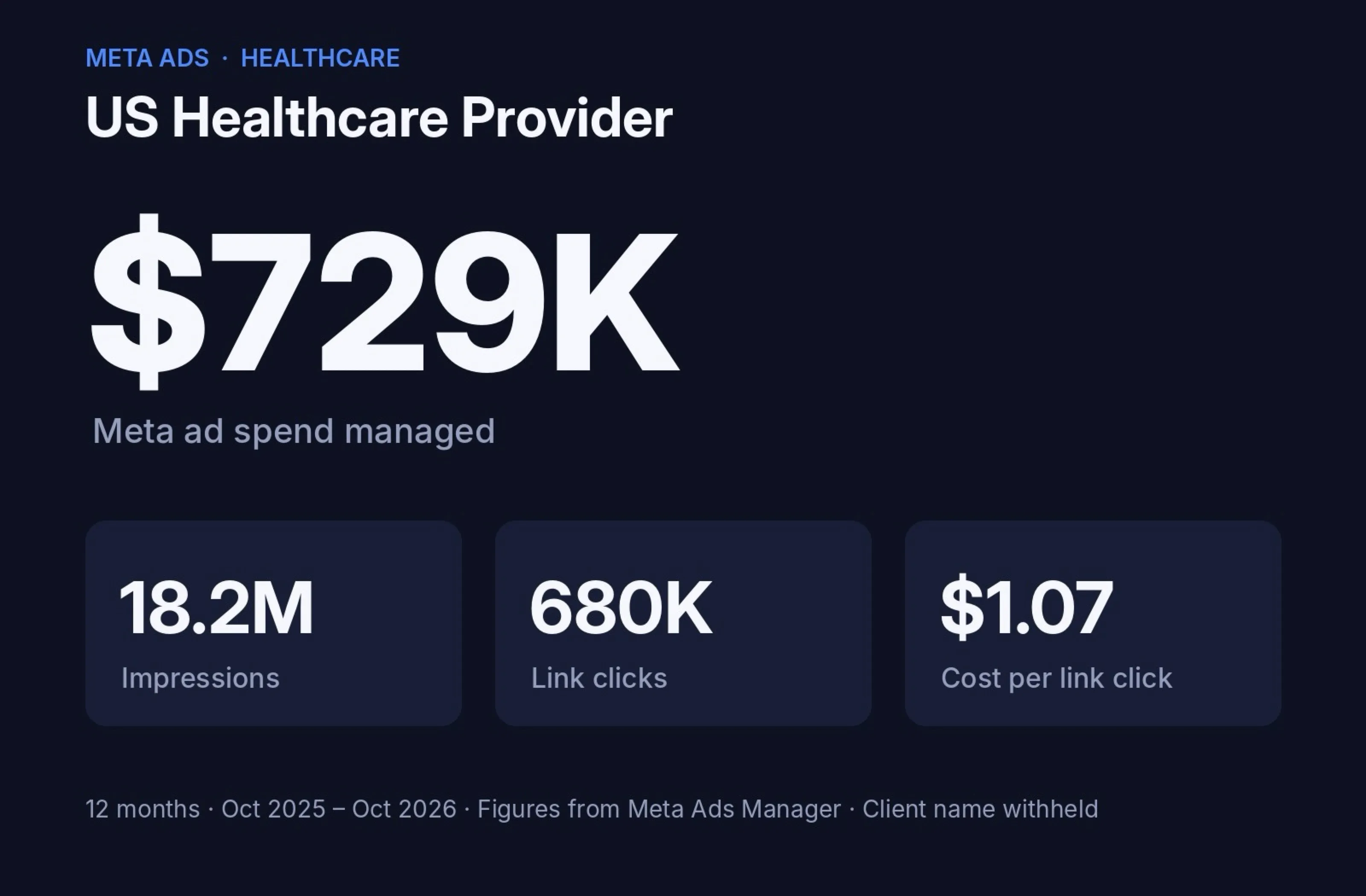
Meta ad spend managed in 12 months at $1.07 per link click
A US healthcare provider needed steady patient demand at scale without traffic costs creeping up. Across two ad accounts and twelve months we managed $728,794 of Meta spend, delivering 680K link clicks at $1.07 each and a 3.7% click-through rate.
Read case study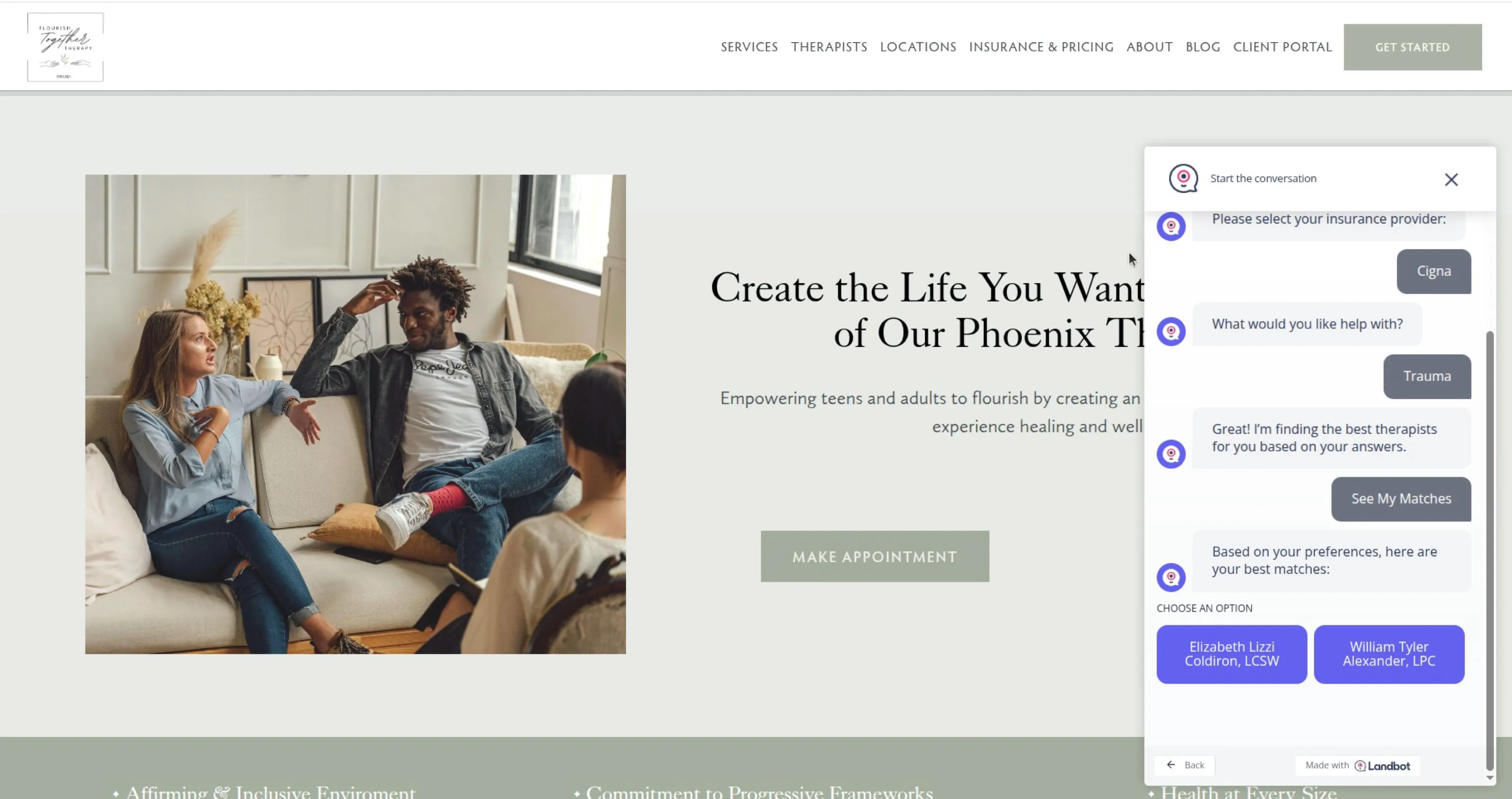
Intake form completion vs the old form
A conversational chatbot for a therapy practice that qualifies prospective clients, matches them to the right therapist, shows insurance options and captures location in a friendly chat flow. Intake completion tripled.
Read case study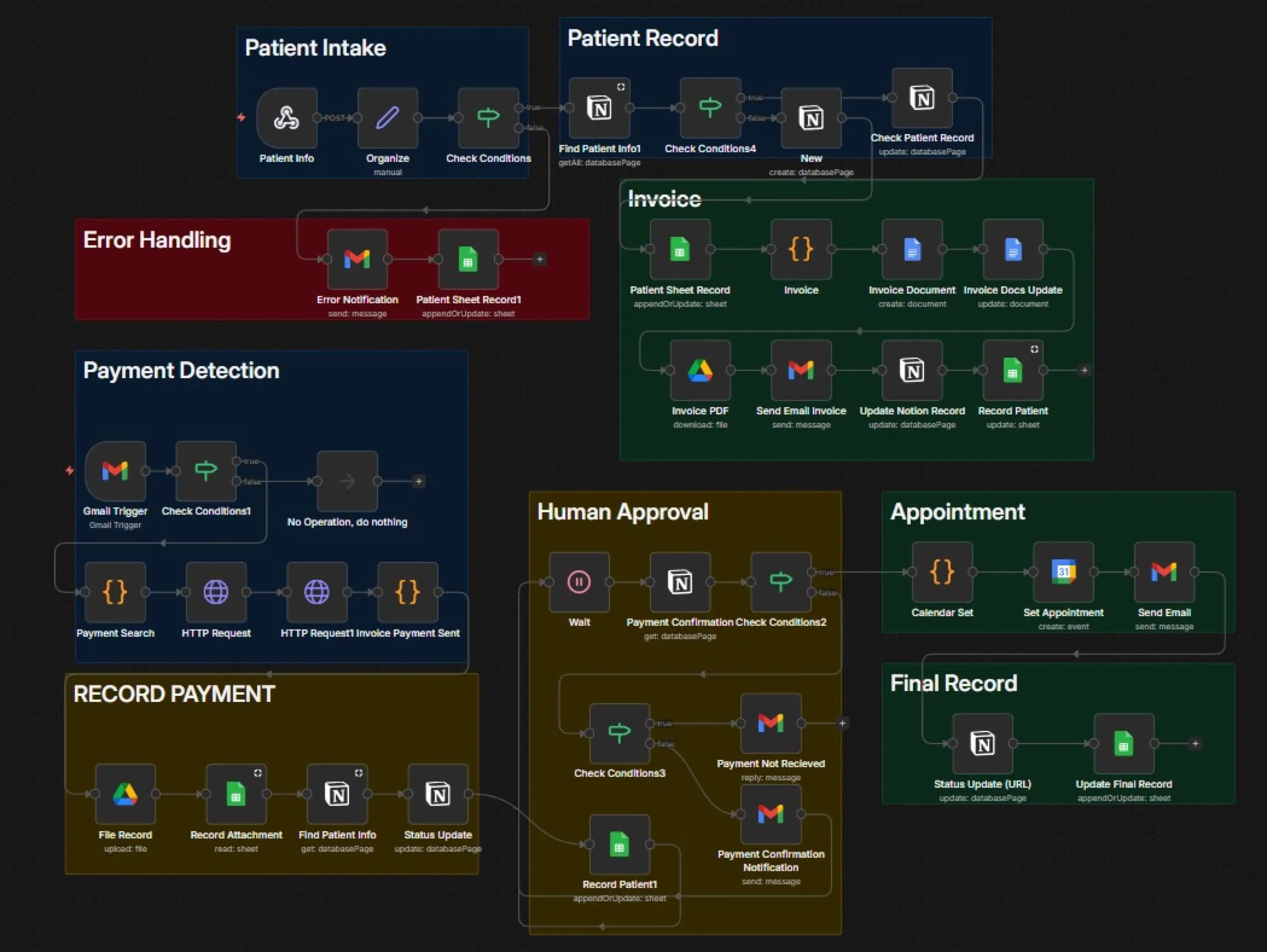
Admin time per patient, with zero manual data entry
A medical clinic handled intake, invoicing, payment tracking and scheduling by hand, with staff switching between four tools per patient. We built an end-to-end n8n automation from intake form to PDF invoice, payment detection in Gmail, calendar booking with a Meet link and live sync to Notion and Sheets. Admin fell by 90%.
Read case study