
The five numbers a webinar funnel actually runs on
Three hundred people registered, eighty turned up and two bought. Somewhere in that chain is one number doing the damage, and it is usually not the one being blamed.
Three hundred people registered, eighty showed up and two bought. The debrief blames the ads, the ads get rebuilt, and the next run produces the same shape of result with a different cost per registration.
A webinar funnel is a chain of five numbers multiplied together. One of them is usually doing most of the damage, and the fix for each is different. Here is the chain, in the order we work through it.
The chain, and where to look first
| Stage | The number | What a change here does |
|---|---|---|
| Registration page | Visitors who register | Multiplies everything downstream, costs nothing in media |
| Ads | Cost per registration | Sets your volume ceiling for a given budget |
| Reminders | Registrants who attend | Decides how many people hear the offer at all |
| The webinar | Attendees who act | Depends on structure and the offer, not charisma |
| Follow-up | Non-buyers who convert later | Usually the largest single source of revenue |
An illustrative run, to show how the multiplication behaves. Spend $2,000 at $2 per registration and you have 1,000 registrations. At a 30% show-up rate that is 300 people live. If 3% buy during the session, that is 9 sales, and if the follow-up window converts another 2% of the registration list, that is 20 more. Now lift the registration page from 20% to 35% and the same $2,000 buys you roughly 1,750 registrations and everything after it scales with that, before you have touched a single ad.
That is why we start at the page.
The registration page: your cheapest lever
The signup rate is the only number in the chain you can change this afternoon for free. Non-negotiables on the pages we build:
- One field. Email, or email plus mobile if you intend to text reminders, and nothing else. Company size, job title and phone extension can be collected later.
- The outcome in the headline, not the title of the webinar. “How to fill a 30-seat course without discounting” beats “Masterclass: Growth Strategies 2026”.
- Date, time and duration above the fold, with the time zone. People will not register for a commitment they cannot see.
- Who it is for, in one line. Naming the wrong audience out loud raises the quality of the registrations you keep.
- Three bullet points of what they will leave with. Specific enough that a competitor could not have written them.
- The presenter, with a reason to listen. One sentence and a photo, not a biography.
- Nothing else. No navigation, no footer links, no second call to action. One page, one action, which is the whole argument behind building pages for the campaign rather than linking the homepage.
We wrote a registration page for a coach who had never run a webinar and it converted 38% of cold paid traffic into registrations. Worth being precise about what that was: cold paid traffic, a one-field form in WebinarJam, and a headline we iterated against the ad’s hook until the two matched. It was not a warm list, and it was not the first version of the page.
Cost per registration: what ads can and cannot fix
Ads control volume and price, not quality of the page. Once the page is good, the levers are the hook, the format and the audience temperature.
For a US campaign we scripted short talking-head video ads around a single method angle and split-tested hooks, ending at about $2 per registration and roughly $20 per booked call. The honest reading: registration cost is a function of market, offer and creative, and $2 in one country for one audience does not transfer to another. What does transfer is the method, which is testing the hook rather than the targeting, and judging ads on cost per booked call rather than cost per registration.
Two practical notes. Keep the gap between registration and session short, because a sign-up three weeks out attends far less reliably than one from yesterday. And run at a budget that can actually learn: below the $1,000 a month we set as a minimum, a webinar campaign cannot gather enough conversions to optimise, and the budget thresholds are worth reading before you commit to a launch date.
Show-up rate and the sequence that drives it
This is the number that moves fastest when you work on it, and the number most funnels leave to a single email.
- On registration: a confirmation page that tells them to add it to their calendar, an email within seconds with a calendar file attached, and a mobile number captured for reminders.
- 24 hours before: email plus SMS or WhatsApp. Restate the one outcome, not the agenda.
- 1 hour before: short message, link included.
- At the moment you go live: the highest-performing message in the whole sequence. “We have started, here is the link.”
- Two hours after: replay link to everyone who did not attend, with an expiry.
Put the sequence in whatever system holds the registrations so the webinar platform, the CRM and the ads agree on who attended. We build these in GoHighLevel when a client has no stack of their own, because registration pages, reminders, pipeline and the follow-up all live in one place.
The webinar itself: teach, then offer
Structure beats delivery. The shape that works:
- Five minutes of framing. What they will leave with, who you are, one promise.
- Thirty to forty minutes of real teaching. Give away the method. Someone who could implement it alone and chooses not to is your best customer.
- A transition you say out loud. “That is the method. If you want us to do it with you, here is how that works.” Attempting to blur teaching into selling loses the room.
- Ten minutes on the offer. What it is, what it costs, what is included, what happens after they buy.
- Live questions, answered properly, including the price objection.
- A deadline with a reason. Cohort start date, seat limit, bonus expiry. Invented urgency gets detected.
Watch the attention graph on the recording. The point where people leave is a content problem at that exact minute, and it is fixable in the next run.
The follow-up window, where most of the revenue closes
In the funnels we run, more revenue closes after the session than during it. Build the follow-up before you promote the webinar.
Over 72 hours to 7 days, segmented three ways:
- Attended, no purchase: replay, the objection you heard most in the live questions, a case example, deadline reminder, final hours.
- Registered, did not attend: replay with a time-limited window, then the same objection sequence one step behind.
- Attended, clicked the offer, did not buy: a human. A call or a WhatsApp message from a person, same day. This is the smallest and most valuable segment in the funnel, and treating it like a list is expensive. The reasoning is the same as in why speed to lead decides who wins the enquiry.
Add one call booking link in every message, because some people never want the recorded answer, they want to ask.
Live or evergreen
Run it live three or four times at least. Live runs tell you where attention drops, which questions recur and which part of the offer confuses people. You cannot learn any of that from a recording.
Move to evergreen when the same recording sells across two or three cohorts without you presenting it. Then the mechanics change: just-in-time sessions starting every fifteen minutes convert better than a weekly slot, and the follow-up has to be triggered per registrant rather than per cohort. One thing we will not build is a replay dressed up as a live session with a fake chat. It converts worse with the people most likely to buy, and it is not recoverable once noticed.
What this looks like when we do it
A first build is usually two weeks: registration, confirmation and replay pages, the reminder sequence, the pipeline, tracking on registration and purchase, and the ads behind it. Then we run it live, read the attention graph and the follow-up numbers, and iterate the page headline against the ad hook. The 38% registration page and the $2 registrations above came from that loop rather than from a first draft.
So the question is not whether webinars still work. It is which of the five numbers in your chain is the weak one, and you can work that out tonight with last run’s registration, attendance and sales counts. Book the free audit if you want a strategist to do that with you, and the one-page plan is yours either way.
Common questions
What is a good webinar funnel conversion rate?
Look at each stage rather than one blended number. The registration page is the one with a clear target: we wrote one that converted 38% of cold paid traffic. Show-up rate, offer conversion and follow-up close depend on price, audience temperature and offer, so measure your own baseline and improve against it.
How do I increase my webinar signup rate?
Cut the form to one field, put the specific outcome in the headline rather than the webinar's title, show the date and time above the fold, and name who it is for so the wrong people self-select out. Then test the headline against the ad's hook, because a mismatch between the two is the most common cause of a low signup rate.
What is a good cost per webinar registration?
It depends on country, audience and offer price. One US campaign we scripted and ran came in at about $2 per registration and around $20 per booked call. The number that matters is cost per registration divided by your show-up and close rates, which is your real cost per customer.
How do I get more people to show up to my webinar?
Collect a mobile number at registration and use it. Send a confirmation with a calendar invite immediately, a reminder 24 hours before, another an hour before, and a message with the link the minute you go live. Keep the gap between registration and the session short, because enthusiasm decays.
Should a webinar funnel be live or evergreen?
Live first, for at least three or four runs, because you learn where attention drops and which questions come up. Move to evergreen once the recording reliably converts, and be honest about it: a replay presented as live costs you trust with exactly the people most likely to buy.
Proof from our work
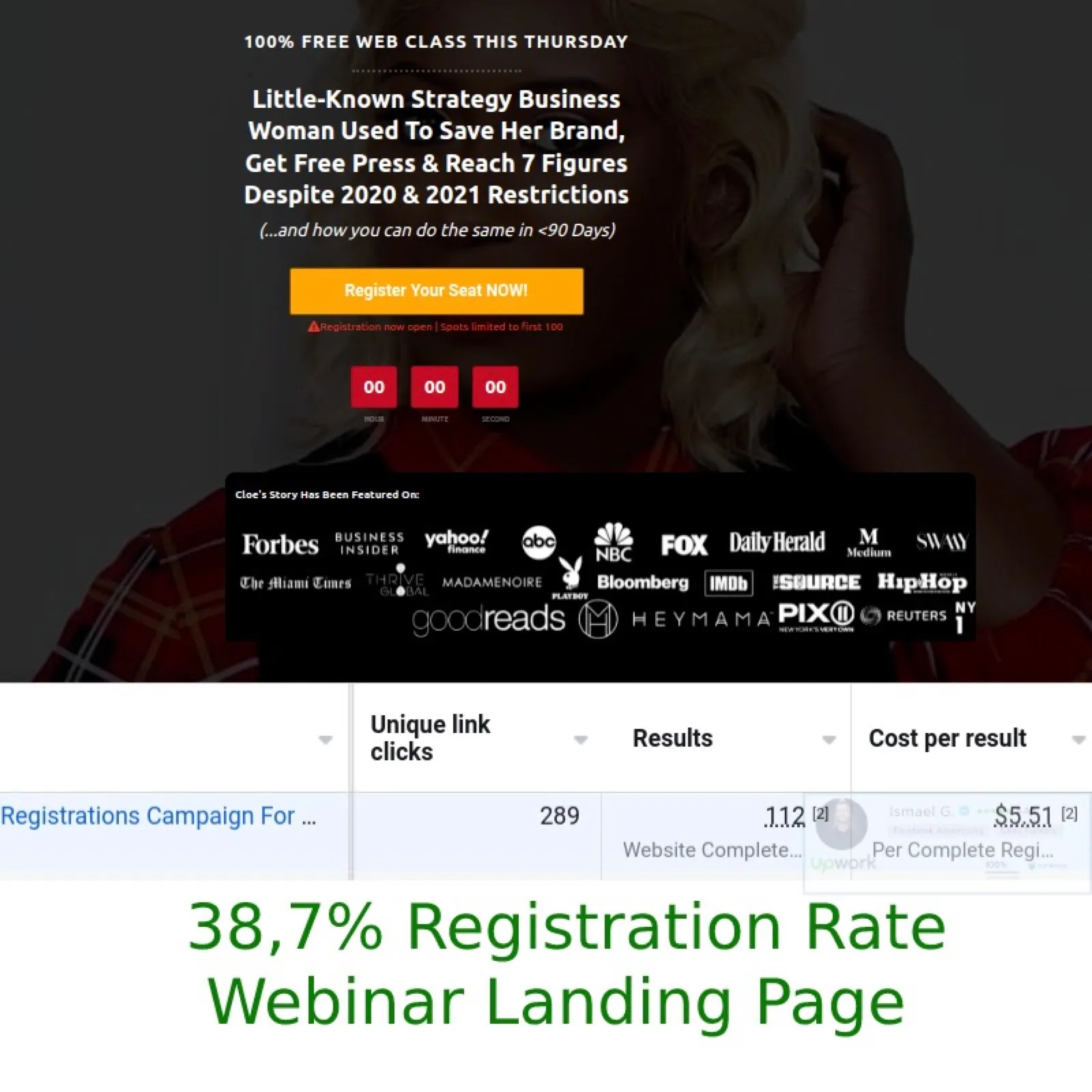
Registration rate from cold traffic
A coach needed a webinar funnel and had never run one. We built the pages, wrote the headline and copy, and launched the ads. The landing page converted 38% of cold traffic into registrations.
Read case study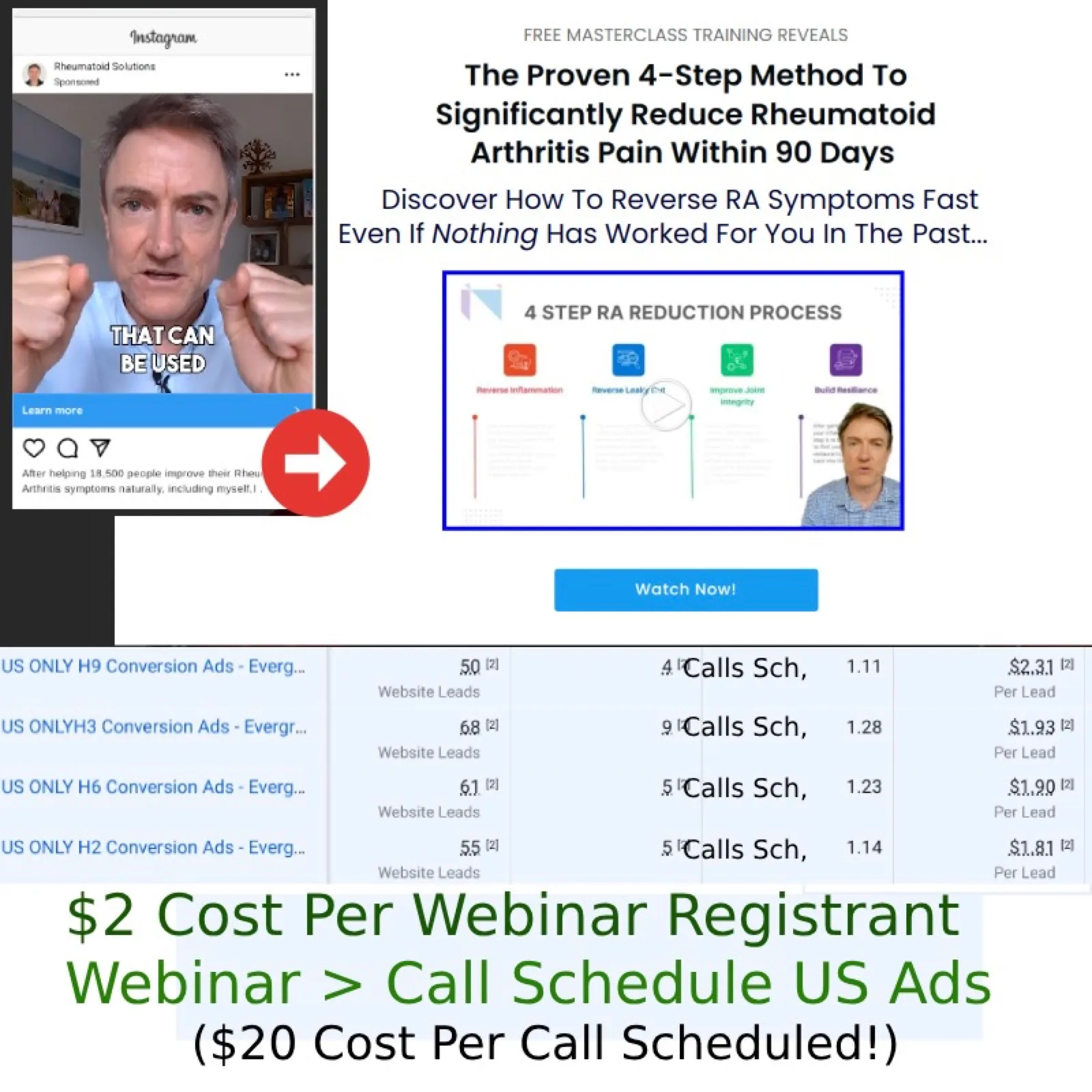
Cost per webinar registration in the US
The client needed to launch webinar ads to a US audience. We scripted the video ads, wrote the copy and ran the campaign, ending at around $2 per registration and $20 per scheduled call.
Read case study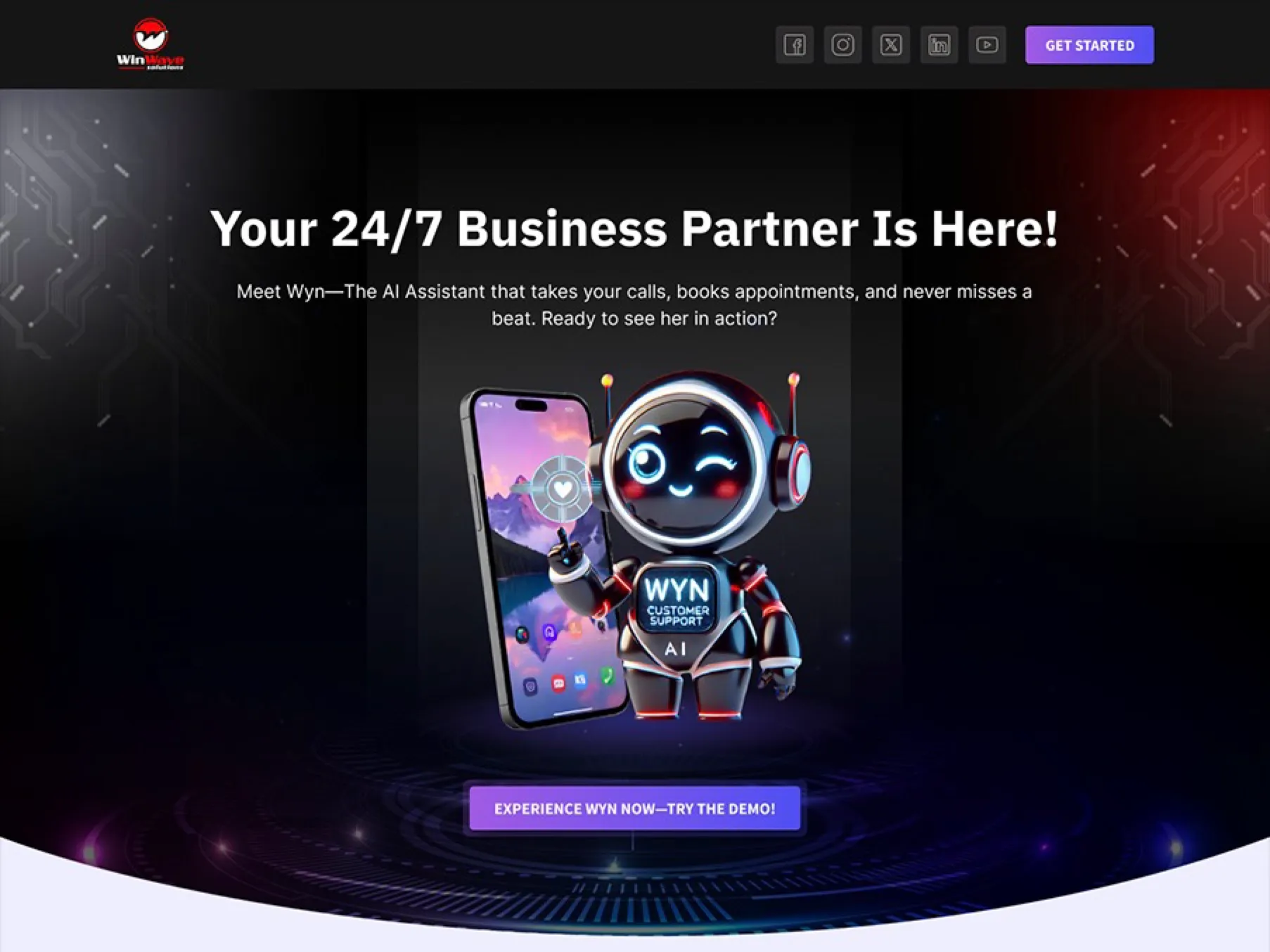
Webinar funnel in GoHighLevel with automation and Facebook ads
- Designed and built the webinar registration, confirmation and replay pages
- Automated reminders and follow-up for registrants
- Created targeted Facebook ad campaigns to fill the webinar